
Cross-border pharmaceutical sourcing requires more than comparing product names and prices. Healthcare businesses should separately verify the manufacturer’s licence and GMP status, product-level regulatory information, batch documentation, storage and transportation requirements, and the import rules of the destination market. This distinction is especially important in China, where the former standalone Drug GMP certification certificates have not been issued since December 1, 2019.
This guide uses current information from Taiwan’s TFDA and China’s NMPA to explain practical checks for healthcare organizations evaluating pharmaceutical sourcing from Taiwan or China.
Separate source-country verification from destination-market requirements
The source country and the destination country answer different questions. At source, verify who manufactured the medicine, where it was made, the manufacturer’s licence, GMP oversight, product specifications, batch information and storage conditions. At destination, verify whether the product is authorized, who may import it, for what purpose, and what rules apply to sale or clinical use.
A product manufactured under an appropriate quality system is not automatically authorized for distribution in another market. Likewise, an approval or export certificate in the source country does not replace the destination country’s import and use requirements.
Taiwan: verify TFDA GMP and GDP information
Taiwan’s Food and Drug Administration (TFDA) maintains public information on pharmaceutical manufacturers and distribution businesses. TFDA’s GMP Pharmaceutical Companies List was updated on August 20, 2026. Its PIC/S GDP dealer list, updated on August 28, 2026, identifies GDP-compliant businesses and describes activities such as storage, transport and cold-chain operations.
For a Taiwan-origin product, do not rely only on a supplier’s statement that it is “PIC/S GMP” or “GDP compliant.” Match the actual manufacturing site and distribution party with TFDA information and then verify the product label, lot, expiry and storage conditions.
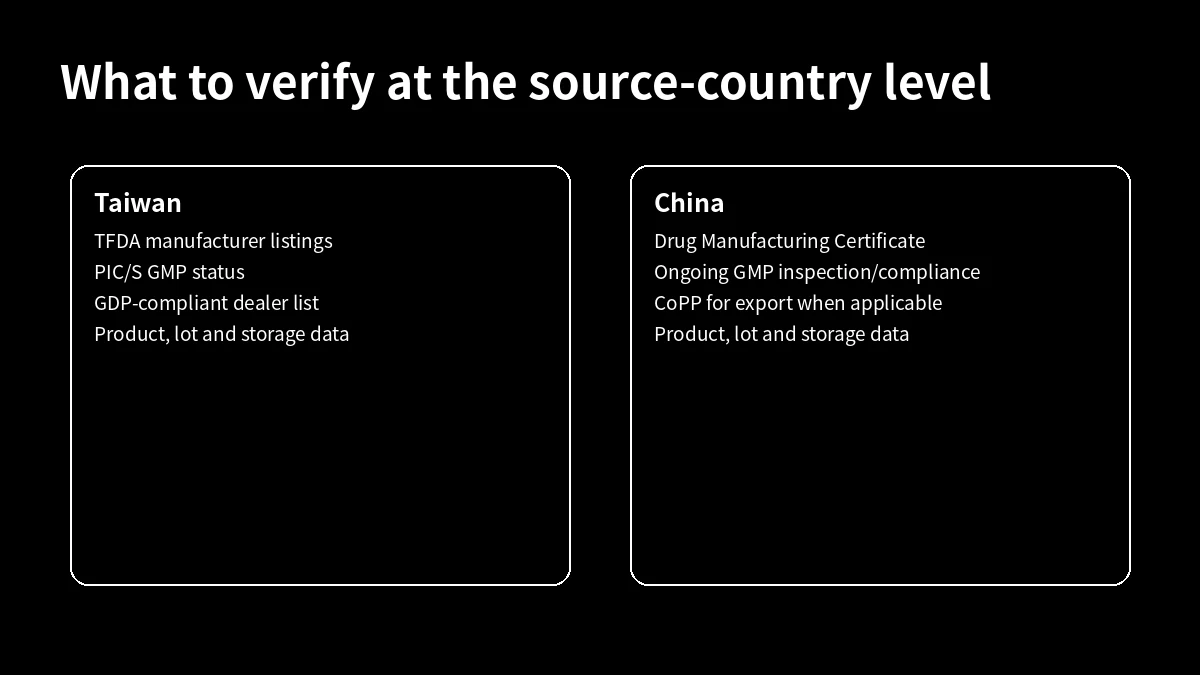
Initial checks for Taiwan-origin products
- Legal manufacturer and actual manufacturing site
- GMP status of the relevant site
- GDP status of storage/distribution parties
- Product name, active ingredient, strength, dosage form and pack size
- Lot number, expiry date and storage temperature
- Availability of batch quality documents such as a CoA
- Documents required by the destination market and transaction
TASAKI PHARMA’s public website states that the company holds pharmaceutical and medical-device GDP certifications in Taiwan and supports healthcare businesses in obtaining Japanese and Taiwanese medical and health products. Availability still needs to be confirmed product by product because manufacturer supply, stock, discontinuation and destination-market regulation may change.
China: verify the Drug Manufacturing Certificate and ongoing GMP compliance
NMPA states that pharmaceutical manufacturing activities require approval from the relevant provincial drug regulatory authority, a Drug Manufacturing Certificate and continuous compliance with GMP.
A common documentation mistake is to ask only for a “GMP certificate.” NMPA’s July 31, 2026 explanatory note states that, since the revised Drug Administration Law took effect on December 1, 2019, China no longer issues Drug GMP certification certificates. Regulatory authorities instead inspect manufacturers and supervise continuing GMP compliance.
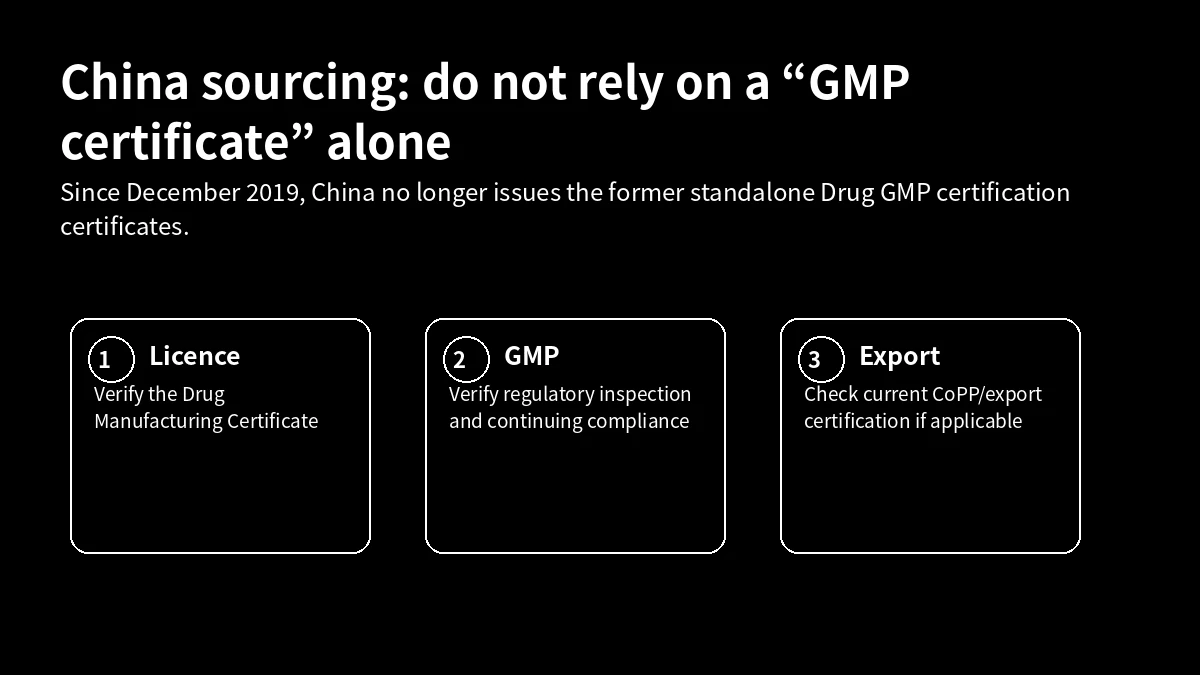
For China-origin products, combine several checks rather than relying on one certificate:
- Drug Manufacturing Certificate and licensed manufacturing scope
- Actual manufacturing site for the product
- Regulatory inspection and continuing GMP-compliance information
- Product registration or marketing status where relevant
- Current CoPP or other export certificate where required and available
- CoA, label, lot, expiry and storage/transport requirements
China updated its pharmaceutical export-certificate framework in 2026
NMPA issued new provisions on inspection and export certificates for pharmaceutical products manufactured for export, effective January 1, 2026. According to NMPA’s policy interpretation, exported pharmaceutical products include preparations, active substances and certain other pharmaceutical products made by manufacturers holding a Drug Manufacturing License and exported to markets where they are regulated as pharmaceuticals.
NMPA also explains that manufacturers may apply for export certification for products manufactured in compliance with GMP even if the products have not been marketed in China, subject to the applicable provisions. Issued CoPPs can be searched through NMPA’s public database.
A CoPP is useful source-country evidence, but it does not grant automatic market access elsewhere. Destination-market authorization and import/use requirements remain separate.
Ten documents and data points to check in cross-border sourcing
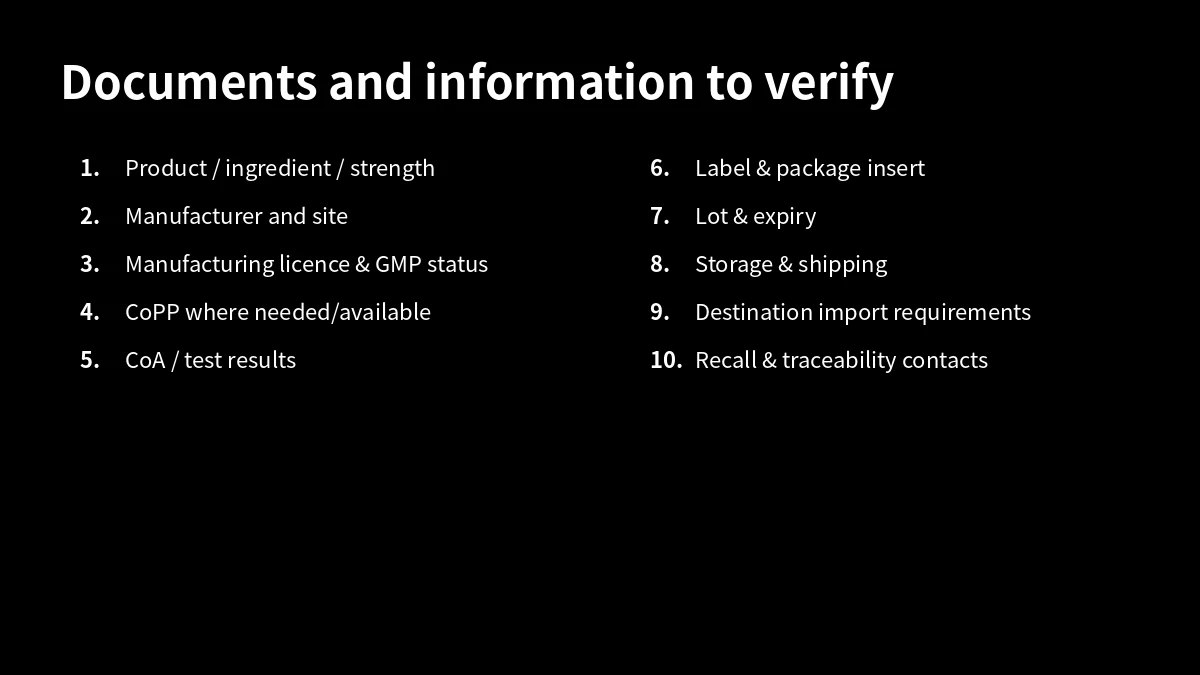
- Product identity: brand/generic name, ingredient, strength, dosage form, pack size
- Manufacturer: legal manufacturer and actual manufacturing site
- Manufacturing licence and GMP: evidence appropriate to the source country’s current system
- Product registration: status in source and destination markets where relevant
- CoPP/export documentation: when required and available
- CoA: batch-specific quality/test information
- Label and package insert: ingredients, directions, warnings and storage
- Lot and expiry: traceability and remaining shelf life
- Storage and transport: ambient, refrigerated, frozen, light protection and excursion handling
- Destination requirements: importer, purpose, authorization and import procedure
Documents such as a Certificate of Origin or patient/product information may also be requested, but the exact set is not universal. Confirm the issuing party and the purpose of each document for the specific transaction.
Japan example: treatment-use imports have separate conditions
For Japan, the Regional Bureau of Health and Welfare explains that import confirmation for a physician’s treatment use is limited to cases where treatment is urgently necessary, no domestic alternative is distributed, and the importing healthcare professional uses the product under their own responsibility for their own patient. The page was updated June 25, 2026.
Accordingly, foreign marketing, GMP compliance or a source-country export certificate does not by itself mean a healthcare institution can freely import and use the product in Japan. Current Japanese import rules should be checked for the specific product and purpose.
Healthcare businesses evaluating international pharmaceutical sourcing
Provide the product name, manufacturer, destination country/region, intended use and expected quantity when contacting TASAKI PHARMA. Availability, accessible quality documents and shipping requirements can then be reviewed for the specific case.
A practical procurement workflow
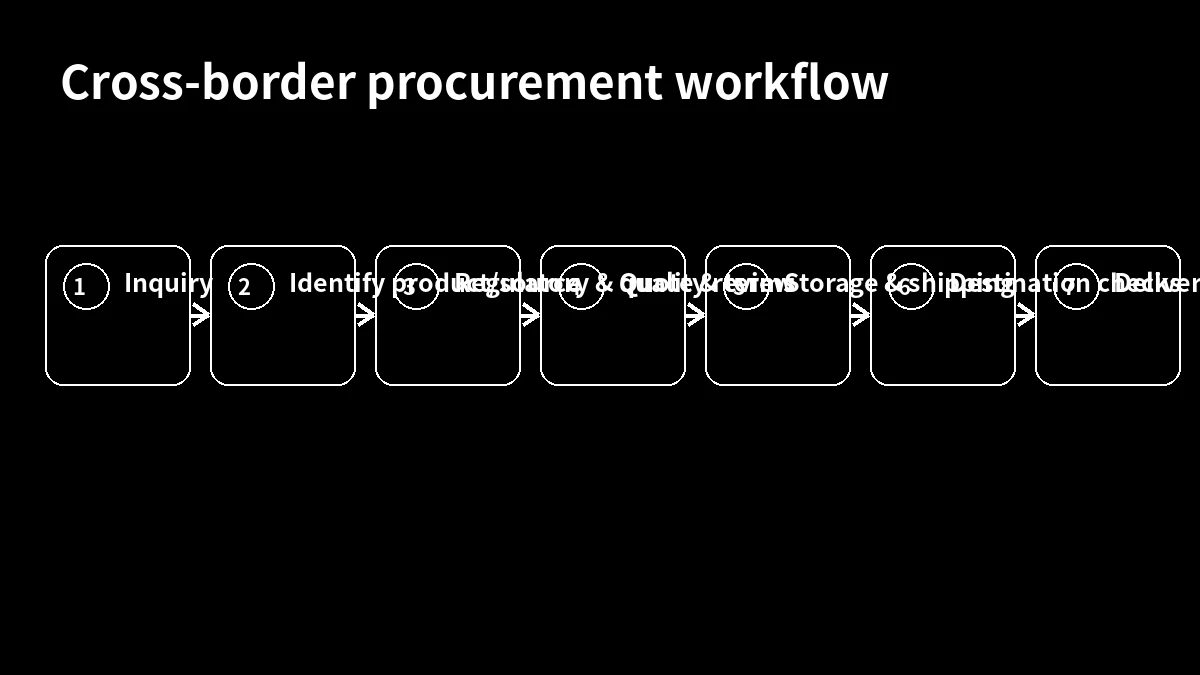
TASAKI PHARMA’s public site presents its international-trade process as Inquiry → Quote → Order/Payment → Stock Up → Delivery. In practice, each step should include specific checks:
- Inquiry: product, manufacturer, destination, use and quantity
- Source verification: manufacturer, distribution route and availability
- Quality/regulatory review: licence, GMP, product documents, lot and storage
- Commercial terms: price, shelf life, shipping conditions and documents
- Destination check: importer, intended use and applicable legal procedure
- Post-delivery: maintain lot, temperature, recall and safety traceability
Decisions to avoid
- Treating manufacturer marketing material as proof of regulatory status
- Relying on isolated terms such as “PIC/S,” “FDA” or “GMP” without checking the exact status
- Assuming source-country compliance equals destination-market authorization
- Selecting suppliers on price alone
- Failing to distinguish the legal seller from the actual manufacturer
- Waiting until after purchase to verify lot, expiry and temperature requirements
How to compare two suppliers offering the same product
Two suppliers can offer a product with the same brand name while presenting materially different procurement risks. Before comparing price, confirm whether both offers refer to the same legal manufacturer, manufacturing site, strength, dosage form, pack configuration and destination-market version. A lower-priced offer is not directly comparable if the remaining shelf life is shorter, the distribution route is unclear, the storage history cannot be demonstrated, or the supporting regulatory documents refer to a different site or product configuration.
For temperature-sensitive products, ask how the shipment will be packed, which party controls each leg of transport, whether temperature records are available, and what happens after an excursion. For ambient products, the same principle still applies: the labelled storage range and any light or humidity requirements should be matched to the shipping plan.
Document dates also matter. Manufacturer licences, inspection status, distribution permissions and product registrations can change. Use current regulator databases where available and match the legal entity name and address carefully. If a certificate or document uses an old company name, site address or regulatory format, confirm why before relying on it.
FAQ
Are all Taiwan-made medicines PIC/S GMP?
Taiwan operates pharmaceutical manufacturing under PIC/S GMP-based oversight, but product-level procurement should still verify the actual manufacturing site and current TFDA information rather than relying on origin alone.
Is a Chinese “GMP certificate” enough?
No. NMPA states that the former standalone Drug GMP certification certificates have not been issued since December 2019. Verify the Drug Manufacturing Certificate, licensed scope, regulatory inspections/continuing GMP compliance, product information and, where applicable, current CoPP/export documentation.
Does a CoPP mean a product can be imported into Japan?
No. A CoPP is one source-country document. Japan’s import and use requirements depend on the product, importer, intended use and authorization status.
Can TASAKI PHARMA review Taiwan- or China-origin products?
TASAKI PHARMA publicly describes support for healthcare businesses sourcing Japanese and Taiwanese medical and health products. For China-origin or other products, the appropriate approach is to provide the exact product, manufacturer, destination, intended use and quantity for a case-by-case sourcing assessment. Availability can change with supply and regulatory conditions.
Conclusion
For Taiwan- and China-origin pharmaceuticals, procurement due diligence should combine manufacturing authorization, GMP oversight, export documentation where applicable, batch quality data, labelling, lot/expiry, storage and shipping requirements, and the destination market’s import rules.
TFDA’s manufacturer/GDP information and NMPA’s Drug Manufacturing Certificate/GMP oversight and 2026 export-certificate framework provide public verification routes. Matching those sources with product-specific documents reduces risks that are invisible in a price-only comparison.
Healthcare businesses evaluating international pharmaceutical sourcing
Provide the product name, manufacturer, destination country/region, intended use and expected quantity when contacting TASAKI PHARMA. Availability, accessible quality documents and shipping requirements can then be reviewed for the specific case.
References
- TFDA GMP Pharmaceutical Companies List
- TFDA PIC/S GDP-compliant dealer list
- NMPA Provisions for the Supervision and Administration of Drug Manufacturing
- NMPA Explanatory Notes on GMP Certificates and CoPP
- NMPA Export Certificate / CoPP Policy Interpretation
- Kinki Regional Bureau: physician treatment-use import guidance