
Korea has become a major source of skin boosters, hyaluronic-acid fillers, PLA/PLLA/PDLLA products, PN/PDRN products, exosome-related products and lipolysis injections. For a clinic or distributor, however, popularity in Korea or the presence of an overseas certification logo is not enough to establish whether a product can be legally supplied or used in another market.
The core questions are regulatory classification, intended use, destination-market authorization, importer status, IFU, formulation, sterility, storage, transportation and lot traceability. Marketing labels such as “skin booster” or “collagen booster” do not determine the legal category of the product.
Start with regulatory classification, not the marketing name
In the United States, FDA regulates many injectable dermal fillers as medical devices. Approved filler materials include hyaluronic acid, calcium hydroxylapatite and poly-L-lactic acid. By contrast, exosome products intended to treat disease or affect the structure or function of the body are generally regulated as drugs and biological products and require premarket review and approval. FDA public information states that there are no FDA-approved exosome products, and FDA continued enforcement involving exosome-related products in 2026.
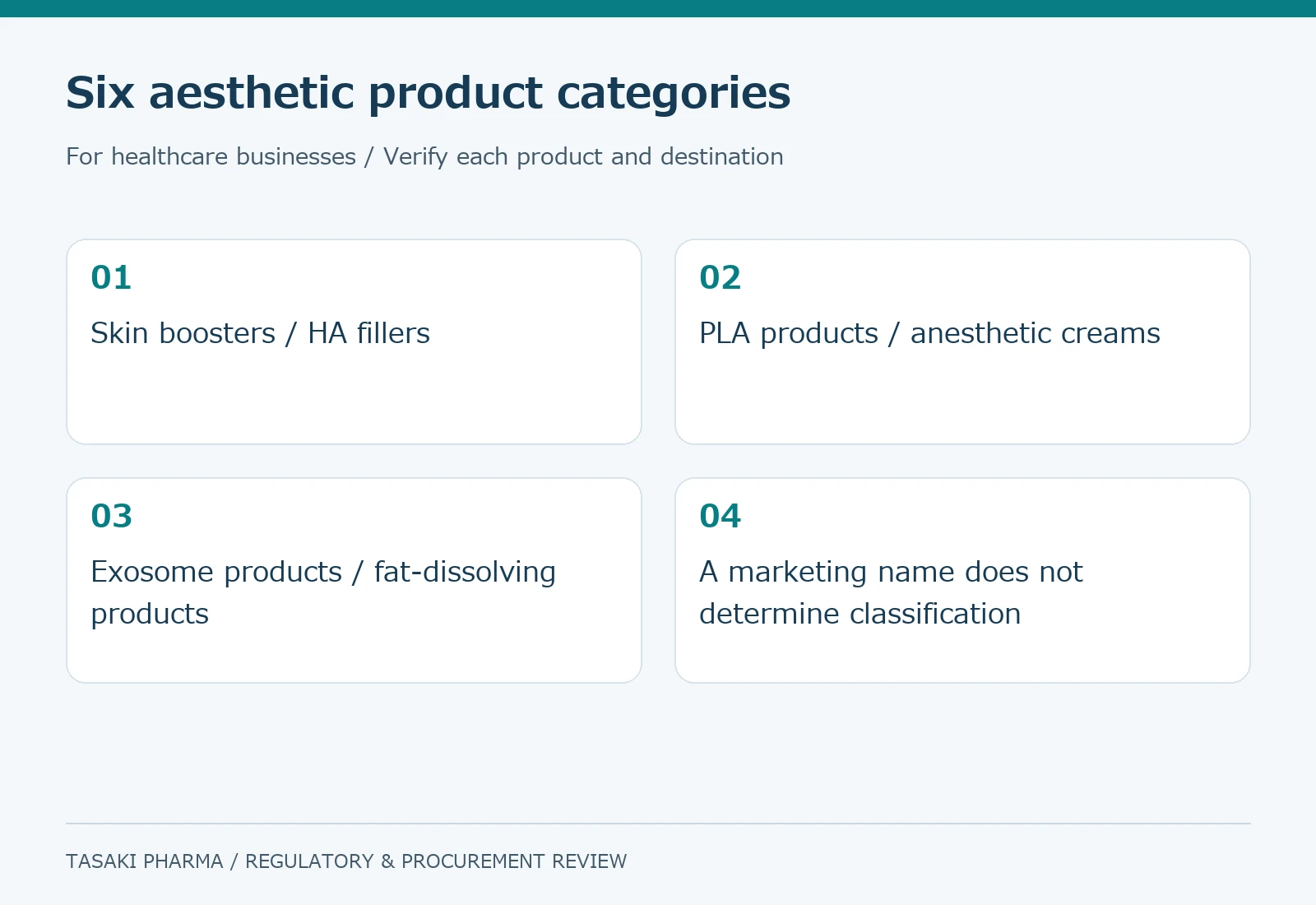
| Category | Key checks | Typical risk of oversimplification |
|---|---|---|
| HA skin boosters / fillers | Material, crosslinking, lidocaine, indication, injection plane, IFU, authorization | Assuming all HA injectables have the same approved uses |
| PLA / PLLA / PDLLA | Polymer, particle size, carrier, preparation, clinical evidence | Treating all “collagen stimulators” as equivalent |
| PN / PDRN | Source, purity, dosage form, route, regulatory category | Mixing marketing claims with approved indications |
| Exosome-related products | Source, manufacturing, quality standards, sterility, legal status | Assuming “exosome” implies validated safety or efficacy |
| Fat-dissolving injections | Active ingredient, concentration, dose, anatomical site, authorization | Extending one product’s indication to other formulas or body areas |
| Topical anesthetic creams | Actives, concentration, prescription status, site, storage | Treating high-strength formulations as ordinary cosmetics |
Japan: physician import is not a blanket route for aesthetic products
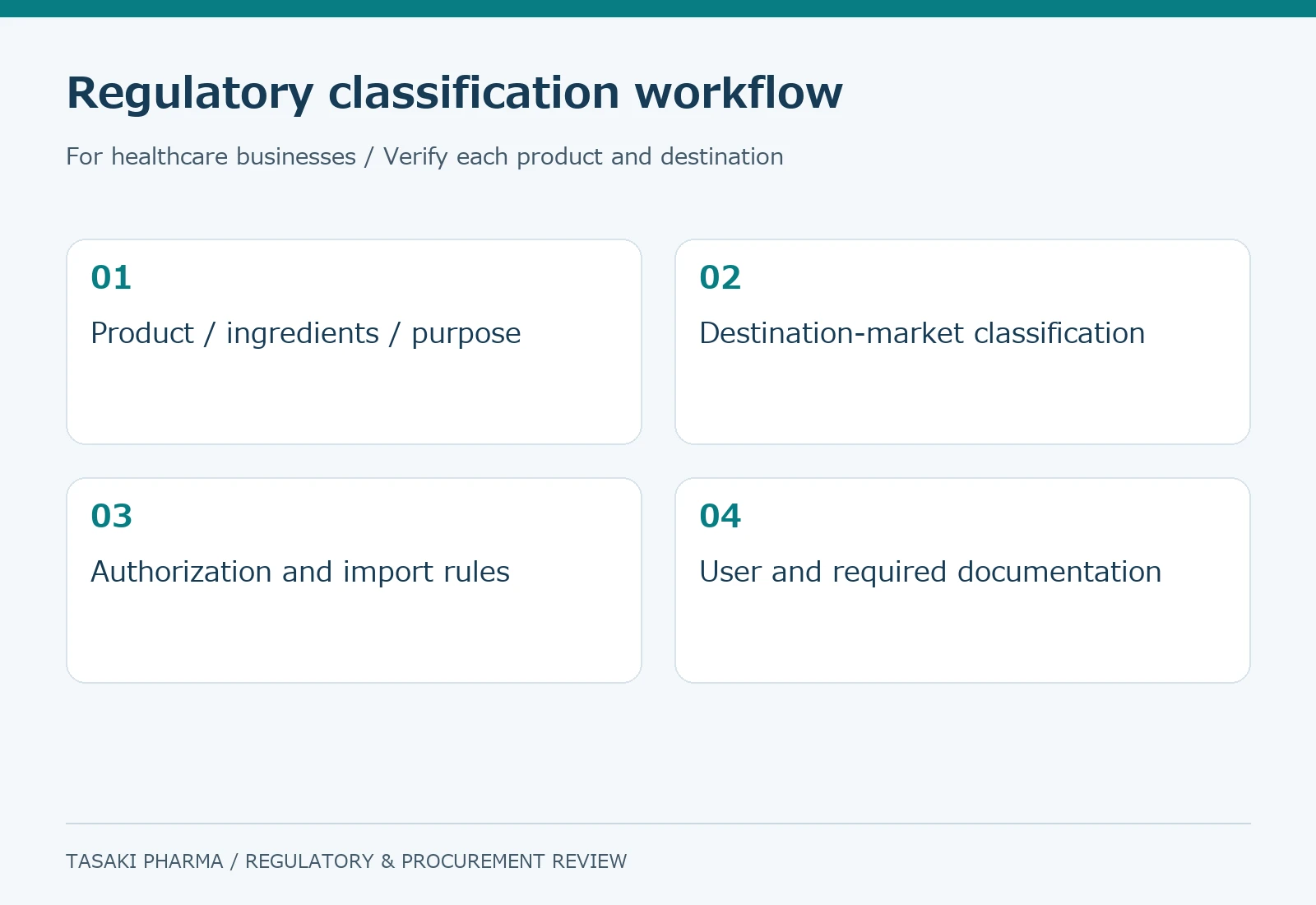
Japan’s regional health bureaus maintain an import-confirmation framework for physicians and other qualified practitioners importing unapproved medical products for treatment. The Kinki Regional Bureau’s June 25, 2026 guidance states that this route is limited to situations where treatment is urgently necessary, no domestic alternative is distributed, and the importing healthcare practitioner uses the product under his or her own responsibility for his or her own patient.
Therefore, “a physician can personally import any overseas aesthetic injectable” is not an accurate general rule. Requirements vary by product classification, purpose, quantity, importer and availability of domestic alternatives.
Ten due-diligence checks before procurement
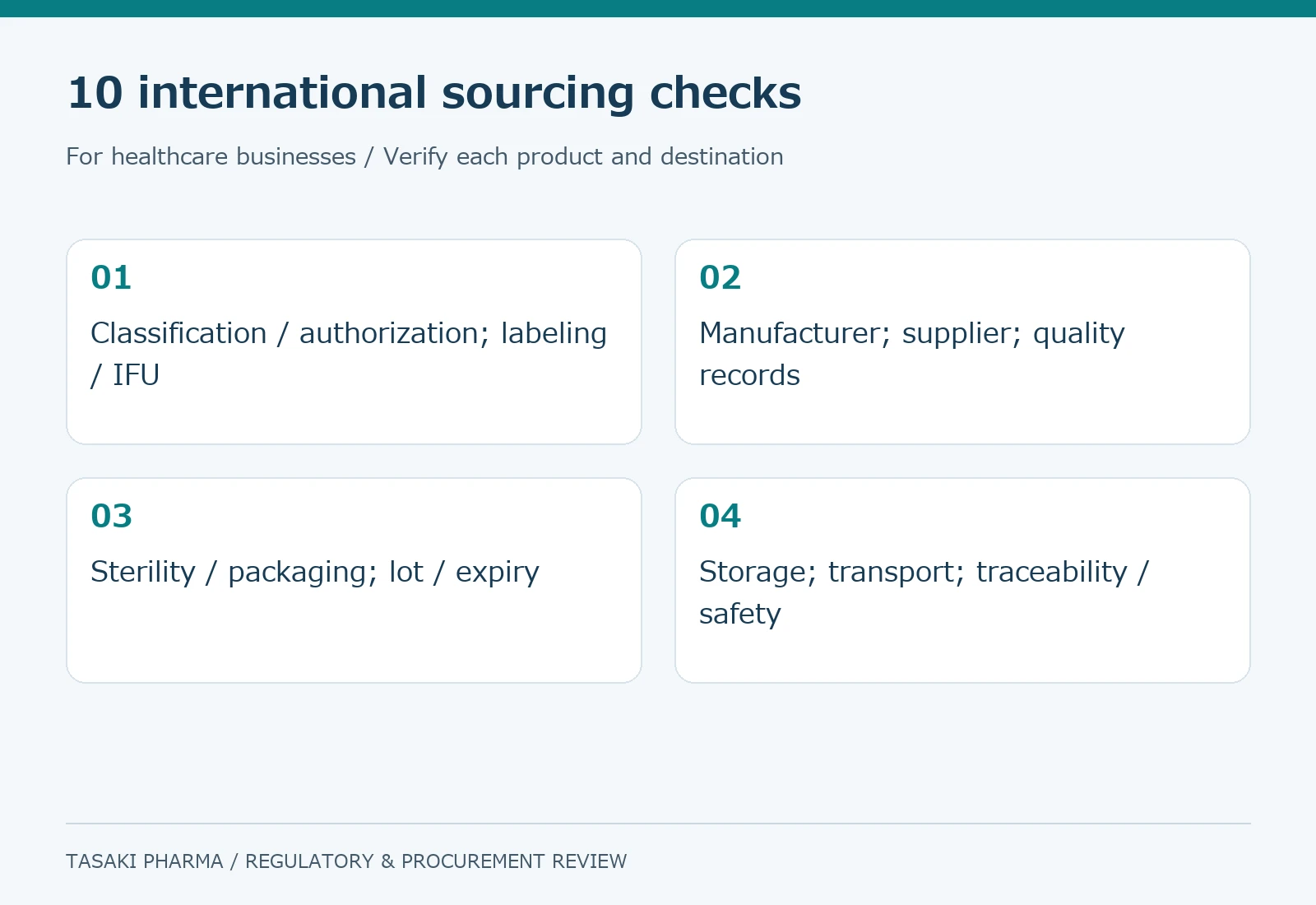
- Manufacturer, legal entity and manufacturing site.
- Regulatory classification in the destination market.
- Exact authorization/registration and intended use.
- Current IFU and labeling.
- Ingredients, concentration and dosage form.
- Sterility, endotoxin/microbial controls and relevant quality documentation.
- Storage and shipping requirements.
- Lot number, expiration and traceability.
- Authenticity and authorized distribution route.
- Recall, field-safety and post-market communication channels.
Category-specific risk points
Skin boosters and HA fillers
Current Japanese search results contain many import-agency and clinic pages focused on product lists, delivery speed and treatment benefits. A B2B procurement decision needs a different layer: what the product legally is, its approved/registered uses, IFU and distribution controls. FDA notes that filler indications differ by product and that inadvertent vascular injection can cause tissue necrosis, visual impairment or stroke.
PLA / PLLA / PDLLA products
TASAKI PHARMA has received proposals from Korean partners for PLA-family injectable products. Claims about duration, particle shape, mixing time or comparative performance should be verified against technical documentation, IFU and clinical evidence rather than copied from sales decks. Existing TASAKI content already addresses Juvelook specifically, so this pillar article focuses on category-level procurement criteria and links to brand-specific content where appropriate.
Exosome-related products
This is a high-risk area for promotional overstatement. FDA states that exosome products intended to treat disease or conditions generally require drug/biologic premarket approval and continues enforcement activity against unapproved products in 2026. Procurement teams should verify source material, manufacturing process, sterility, release specifications, intended use and destination-market legal status before considering clinical use.
Fat-dissolving injections
FDA has reported adverse events including scarring, infection, skin deformities and painful nodules after use of unapproved fat-dissolving injections. On September 15, 2026, FDA added warnings to Kybella labeling based on serious adverse events associated with unapproved use outside the submental area. Manufacturer claims for use on the abdomen, arms, thighs or other areas should therefore never be treated as approved indications without independent confirmation.
Topical anesthetic creams
High-strength lidocaine or combination anesthetic creams should be evaluated as regulated medicinal products where applicable, not simply as accessories to aesthetic procedures. Confirm the destination-market category, prescription requirements, concentration, labeling and storage.
TASAKI PHARMA can review sourcing feasibility, required documentation and logistics on a case-by-case basis. Provide the product and manufacturer name, destination country, intended use, quantity and timeline. Availability is not guaranteed and may be restricted by regulation, manufacturer policy or supply conditions.
Contact TASAKI PHARMA
Do not treat “FDA”, “CE” or “CPNP” as interchangeable endorsements
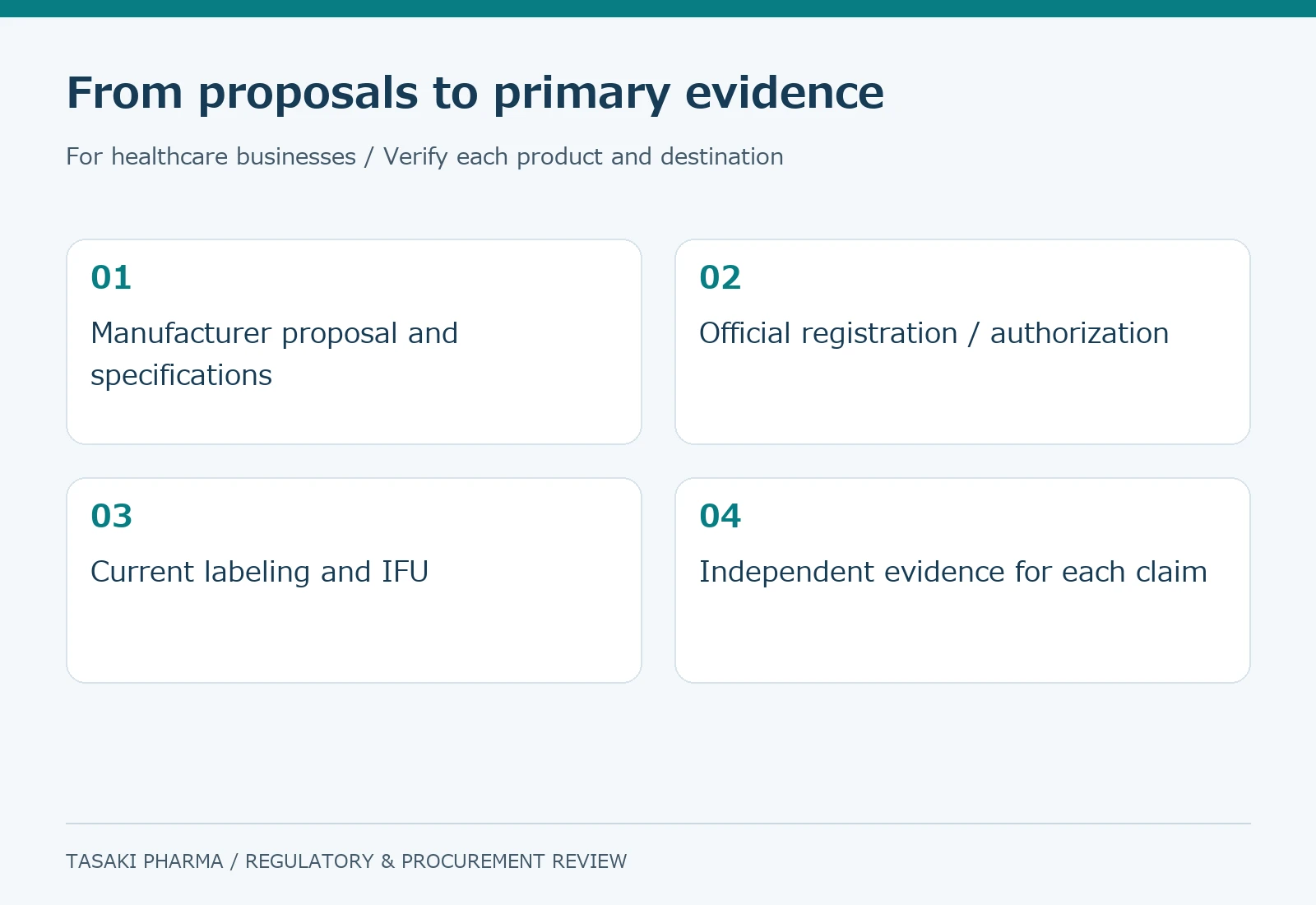
Sales decks often place multiple regulatory logos side by side, but they refer to different systems and may cover different product categories and intended uses. FDA clearance and PMA approval are different pathways. CPNP is an EU cosmetics notification portal and is not an approval for a drug or medical device. Always verify exactly what product, use and legal pathway a claim refers to.
Regulatory logos do not replace product-specific evidence
Commercial materials for aesthetic products frequently display “FDA,” “CE,” “CPNP” or similar terms together. These terms do not describe the same type of regulatory review. FDA 510(k) clearance, FDA PMA approval, EU medical-device conformity assessment and cosmetic notification systems address different product categories and legal requirements. Procurement teams should ask for the exact certificate or database entry, match the legal manufacturer and product name, and confirm the intended use covered by the document.
This point is particularly important when a Korean product is offered through a distributor rather than directly by the manufacturer. A certificate issued to another product, another manufacturer, a different formulation or a cosmetic version of the brand should not be assumed to support an injectable product.
Authenticity and supply-chain controls
Aesthetic injectables are high-value products that often move through international distribution channels, creating opportunities for counterfeit, diverted or improperly stored goods. Due diligence should include the manufacturer’s authorized distributor list where available, invoice and shipment records, lot and expiration data, package integrity, serial or UDI information where applicable, and a documented contact route for recalls and safety communications.
Price should not be the only procurement metric. An unusually low quotation may reflect parallel trade, short-dated stock, incomplete documentation, storage uncertainty or a non-authorized source. A defensible procurement process records the source, batch, conditions of transport and documentation reviewed before release to the clinic.
How TASAKI PHARMA evaluates new Korean product proposals
During 2026, TASAKI PHARMA received multiple proposals from Korean manufacturers and partners covering amino-acid/HA products, PLA-family injectables, exosome-related products and lipolysis products. A proposal is treated as a sourcing lead, not as proof that the product is currently available for every market or suitable for clinical use.
Before moving from a proposal to a procurement discussion, the product information needs to be separated into three layers: manufacturer claims, independently verifiable regulatory/technical information, and destination-specific import requirements. Claims that cannot be verified are not converted into clinical statements. This approach reduces the risk of marketing language being mistaken for an approved indication or established evidence.
FAQ
Can a Korean aesthetic product be imported into Japan simply because it is used in Korea?
No blanket conclusion is possible. Product classification, importer, purpose, domestic alternatives and quantity affect the applicable process.
Does an FDA or CE logo prove a product is safe for any aesthetic use?
No. Verify the exact product, intended use and regulatory pathway. A logo in a sales document is not sufficient evidence of authorization for every use.
Are exosome products freely importable for aesthetic clinics?
Requirements differ by country and product. In the U.S., FDA treats exosome products intended to treat disease or affect body structure/function as regulated drugs/biologics requiring premarket review and states that no exosome products are currently FDA-approved.
Are all fat-dissolving injections equivalent?
No. Active ingredients, concentrations, sites of administration, labeling and authorization differ. Unapproved products and unapproved body-area use can carry significant safety risks.
Conclusion
For Korean aesthetic injectables, procurement quality depends less on trend or price than on classification, evidence and traceable distribution. Review authorization, IFU, formulation, sterility, storage, shipping, lot controls and current safety information before any clinical introduction.
Share the product, manufacturer, destination market, intended use and quantity so TASAKI PHARMA can review sourcing feasibility, documentation and logistics where possible.
Contact TASAKI PHARMA
Information current as of October 2026. This article is for healthcare businesses and does not guarantee product efficacy, safety, authorization, importability or availability.
References
- 厚生労働省・近畿厚生局:医師等が治療に用いるために輸入する場合
- 厚生労働省:医薬品等輸入確認証交付件数(令和6年度)
- 関東信越厚生局:医薬品等の輸入手続について
- FDA:Dermal Fillers (Soft Tissue Fillers)
- FDA:FDA-Approved Dermal Fillers
- FDA:Consumer Alert on Regenerative Medicine Products Including Stem Cells and Exosomes
- FDA:Using Fat-Dissolving Injections That Are Not FDA Approved Can Be Harmful
- FDA:Kybella labeling update, September 15, 2026
- 田崎藥品:日本語ホーム
- 田崎藥品:ヒアルロン酸 輸入
- 田崎藥品:ジュベルック輸入
- 田崎藥品:医薬品の偽造品対策
- FDA: Blue Horizon International Warning Letter (May 26, 2026)
- FDA: R3 Medical Companies Warning Letter (Aug. 14, 2026)