Rare-disease medicines can have very different regulatory and commercial status from one country to another. A therapy may be authorised and stocked in one market but unregistered, not launched, discontinued or supply-constrained in another. For hospitals and healthcare businesses, international sourcing therefore requires more than identifying an “orphan drug.” The exact product, marketing status, lawful import pathway, supplier, batch documentation, storage conditions and continuity of supply all need to be verified.
This article outlines a practical due-diligence framework for healthcare organisations considering cross-border sourcing when a rare-disease medicine is difficult to obtain locally. Importability and clinical use depend on the specific product, importer, purpose and destination-market rules; current regulator information must always take priority.
Orphan designation is not the same as marketing authorisation
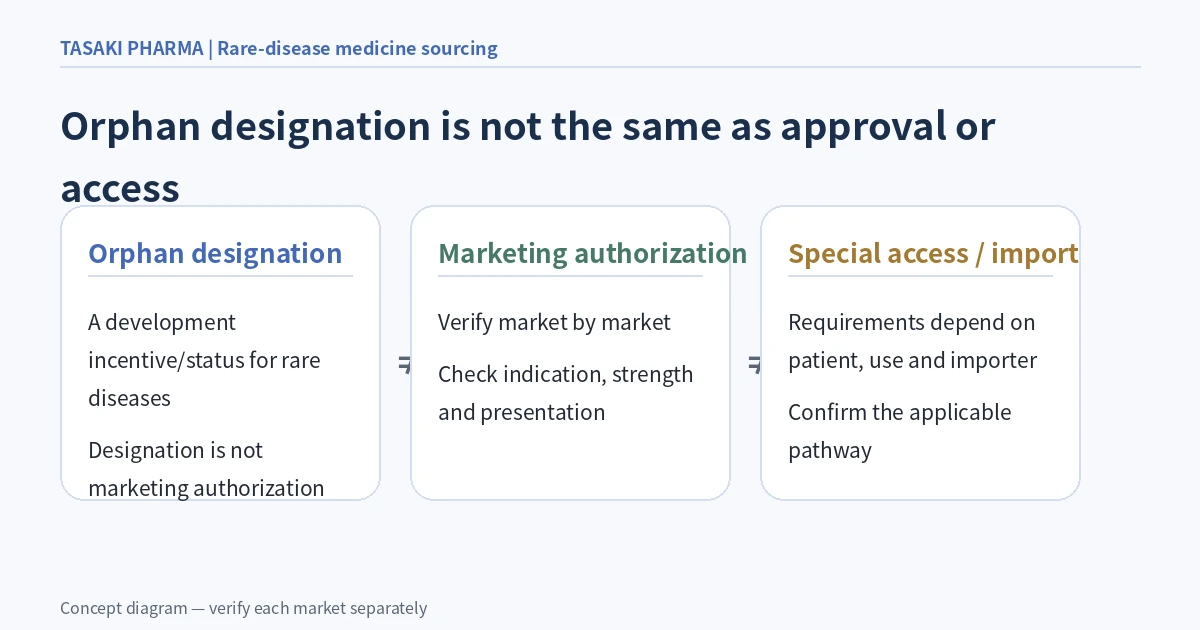
Regulators use orphan-designation programmes to encourage development for rare diseases, but designation itself is not a marketing authorisation. Japan's Ministry of Health, Labour and Welfare states that orphan designation applies to products meeting criteria including fewer than 50,000 patients in Japan and high medical need, and explicitly notes that designation does not automatically lead to marketing approval. FDA likewise describes orphan designation as a process separate from approval or licensing. In the EU, orphan designation generally applies to life-threatening or chronically debilitating conditions affecting no more than 5 in 10,000 people, together with additional criteria.
For procurement, this means a team should separately confirm whether a product is designated, authorised, commercially launched and currently available in the relevant market.
Why a rare-disease medicine may be difficult to obtain locally
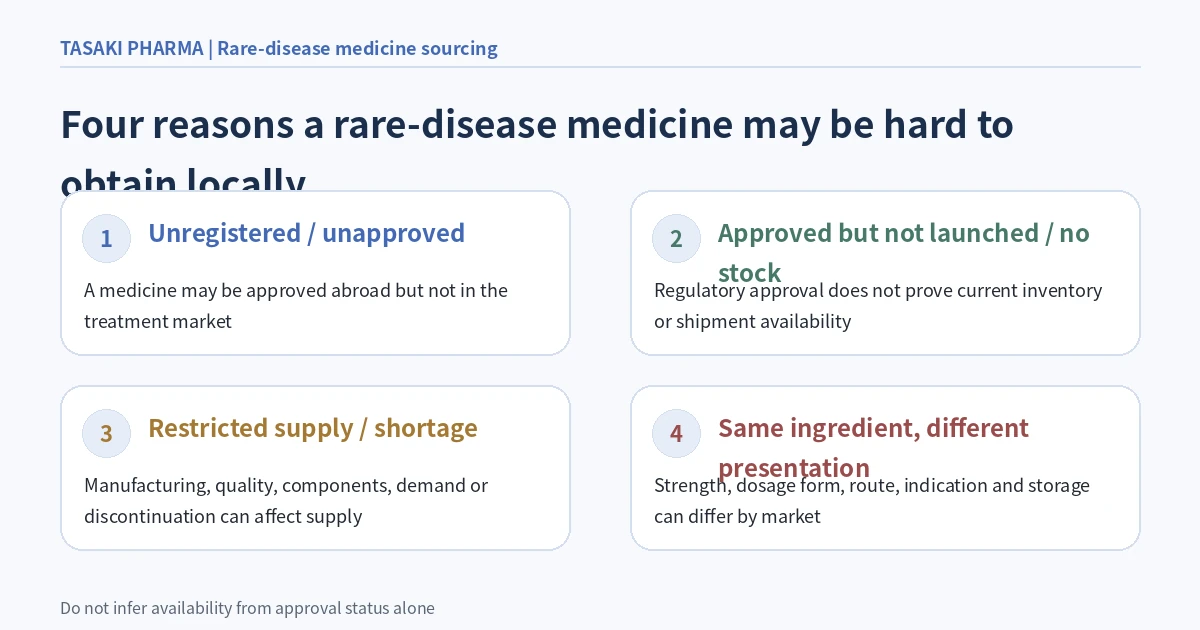
- Unregistered or unlicensed locally: the medicine is authorised elsewhere but has not obtained local marketing authorisation.
- Authorised but not commercially available: the product may be approved but not launched, temporarily unavailable or not routinely stocked.
- Shortage or supply interruption: manufacturing, quality, raw-material, demand or discontinuation issues can restrict supply.
- Market-specific differences: the same active substance may have different strengths, dosage forms, indications, manufacturers or storage conditions across countries.
FDA notes that drug shortages can arise from manufacturing and quality problems, production delays, raw-material or component delays, unexpected demand increases and discontinuations. Japan's MHLW publishes current information on limited shipments and supply stops. These checks help determine whether the problem is product-specific, market-specific or part of a wider supply disruption.
Ten checks before cross-border sourcing
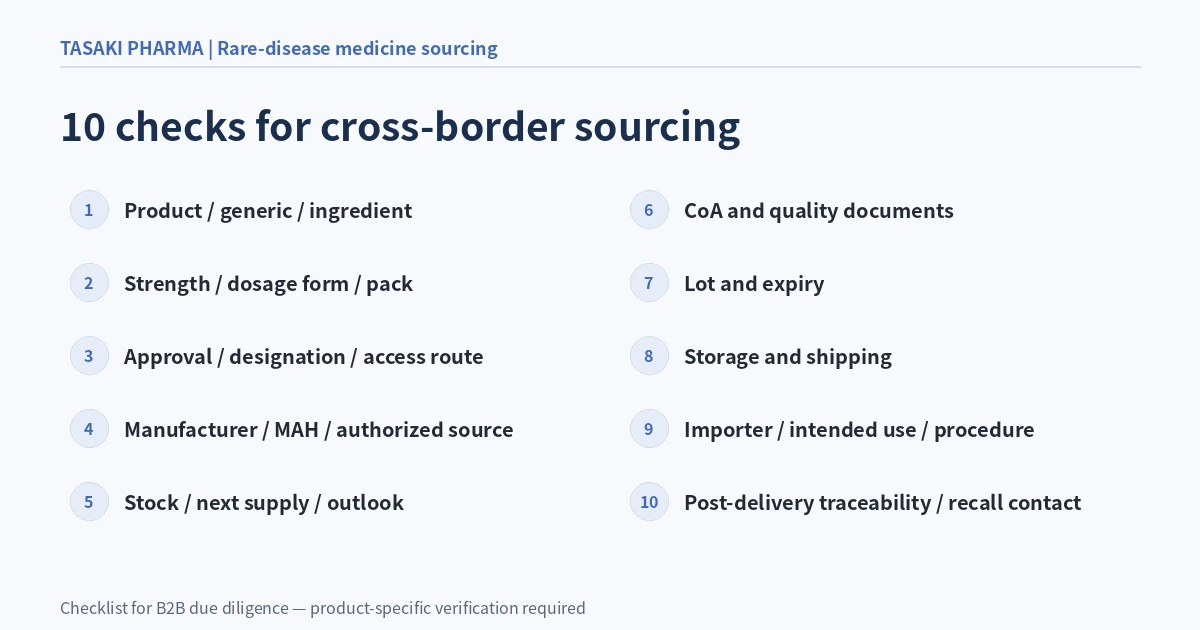
- Confirm the exact product identity: brand/generic name, ingredient, strength, dosage form and pack size.
- Separate orphan designation from marketing authorisation and commercial availability.
- Verify the legal manufacturer, marketing authorisation holder and authorised distribution route.
- Check current stock, allocation, discontinuation status and expected recovery.
- Confirm the proposed batch, expiry date and remaining shelf life before purchase.
- Obtain batch and product documentation such as the CoA, label and package insert where applicable.
- Match storage and transport to the labelled temperature, light and handling requirements.
- Confirm the destination-country import pathway, responsible importer and intended use.
- Maintain access to safety, recall and batch-traceability information.
- Plan continuity: lead time, repeat supply, alternate source options and what happens if the next shipment is delayed.
Ask about rare-disease medicine sourcing
Japan example: physician treatment-use imports have specific conditions
Japan's Kinki Regional Bureau of Health and Welfare states in guidance updated June 25, 2026 that physician treatment-use imports are limited to cases where treatment is urgently necessary, no domestic alternative is distributed, and the importing healthcare professional uses the imported product under their own responsibility for their own patient. The page also lists documentation such as professional credentials, invoices and shipping documents, with additional documents required in some cases.
Accordingly, orphan status or foreign approval alone does not create a general right to import a medicine into Japan. The current import-confirmation requirements must be assessed for the specific case.
Taiwan example: special import routes exist for rare-disease medicines
Taiwan's TFDA publishes materials for special import of rare-disease medicines, including annual-use evaluation forms for specially imported rare-disease products and guidance distinguishing different special-import categories. Healthcare institutions should verify the current TFDA pathway, eligibility, documentation and responsibilities for the specific product and patient situation.
Supplier due diligence: authenticity and continuity come before price
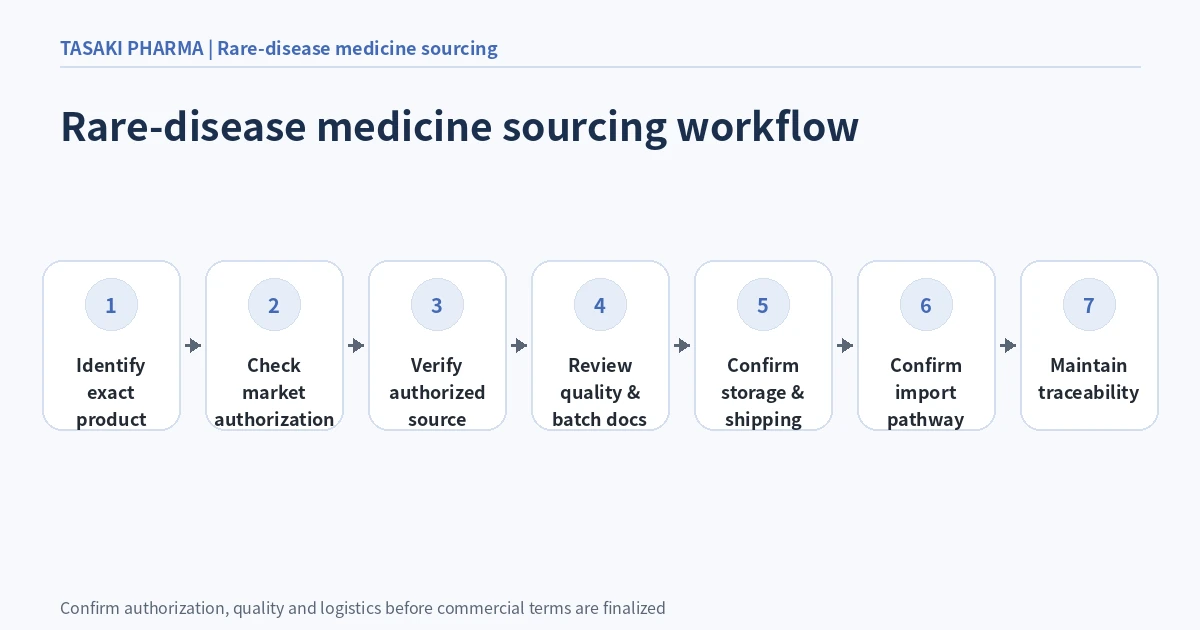
Rare-disease medicines may move through narrower distribution networks than high-volume products. When comparing suppliers, confirm the approved market of origin, the relationship between manufacturer, marketing authorisation holder and distributor, batch and expiry information, storage history, transport validation and the route for recalls or safety communications.
For refrigerated or frozen products, ask how each transport leg will be controlled, whether temperature records are available, what packaging is validated for the route, and how excursions are assessed. A promise of “cold-chain shipping” is not enough if it cannot be matched to the product's labelled conditions.
Databases can help identify candidate products, but product discovery is only the first step. Availability, legal market status, documentation, import pathway, storage and continuity must still be checked before procurement.
FAQ
Does orphan designation mean the drug is approved?
No. Orphan designation and marketing authorisation are separate regulatory concepts. Confirm both designation and current approval/marketing status in each relevant jurisdiction.
Can an overseas version automatically replace a medicine in shortage?
No. Strength, dosage form, route, indication, excipients and labelling may differ, and import rules may apply. Clinical substitution is a professional medical decision, while importability is determined under the destination market's legal framework.
What information should a hospital provide when requesting a sourcing check?
Provide the product or active ingredient, manufacturer if known, required strength and dosage form, destination country, treating institution, intended use, quantity, required timing and any known shortage or availability information.
Conclusion
International sourcing of rare-disease medicines is a chain of checks: designation, marketing status, authentic source, batch documentation, logistics, destination-country import pathway and continuity. The reason the medicine is difficult to obtain—unregistered, not launched, in shortage or discontinued—also affects the appropriate sourcing strategy.
TASAKI PHARMA reviews specific sourcing enquiries from healthcare-related businesses based on the product, manufacturer, destination, intended use and quantity. Procurement decisions should consider quality documentation, transport, destination-market requirements and continuity of supply rather than price alone.
Ask about rare-disease medicine sourcing