Audience: healthcare institutions, pharmaceutical distributors, importers and other healthcare businesses
The U.S. presbyopia treatment landscape changed materially in 2025–2026 with the approval of new prescription eye drops, including VIZZ (aceclidine ophthalmic solution 1.44%) and YUVEZZI (carbachol and brimonidine tartrate ophthalmic solution 2.75%/0.1%).
Both products use pharmacologic miosis to extend depth of focus and improve near vision, but they differ in active ingredients, dosing, clinical-study design, storage requirements and logistics. For healthcare businesses evaluating cross-border supply, FDA approval is only one part of the assessment. Current labeling, destination-market authorization, sourcing route, temperature controls, shelf life and import requirements also need to be verified.
This article summarizes what can be verified from current U.S. FDA labeling as of October 2, 2026 and highlights the procurement questions that matter before shipment.
Why presbyopia eye drops are attracting attention
Presbyopia is the age-related decline in the eye’s ability to focus at near. Reading glasses, contact lenses and surgical options remain standard approaches, but U.S. prescription eye drops have expanded the non-surgical options available to adults.
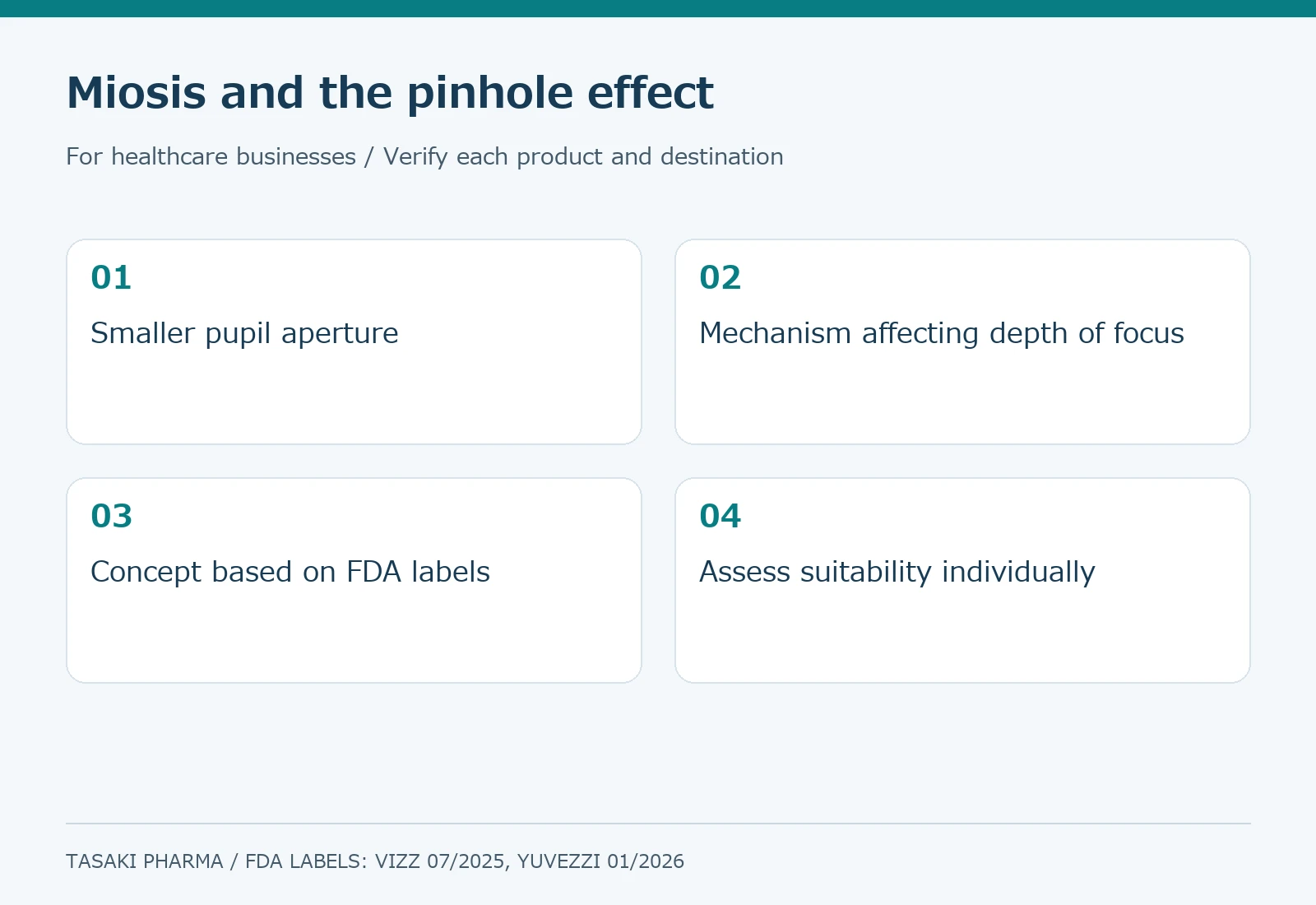
These drugs do not reverse age-related changes in the crystalline lens. Instead, miotic activity reduces pupil size and creates a pinhole effect that increases depth of focus. Because the mechanisms, dose schedules and safety profiles differ by product, procurement and clinical review should be product-specific rather than based on the general label “presbyopia drop.”
VIZZ vs YUVEZZI: key label-based differences
| Item | VIZZ | YUVEZZI |
|---|---|---|
| Active ingredient(s) | aceclidine 1.44% | carbachol 2.75% + brimonidine tartrate 0.1% |
| Initial U.S. approval | 2025 | 2026 |
| Indication | presbyopia in adults | presbyopia in adults |
| Daily dosing | 1 drop/eye, wait 2 min, then second drop/eye; once daily | 1 drop/eye once daily |
| Label efficacy timepoints | assessed from 30 min through 10 h | assessed from 30 min through 8 h |
| Standard storage | refrigerated 2–8°C, do not freeze | 2–25°C |
| After removal from refrigeration | ≤25°C, use within 30 days | label storage range is 2–25°C |
| Shipping excursion | FDA label permits up to 40°C for no more than 8 days | verify shipment against manufacturer/distributor specifications and the 2–25°C label range |
| Presentation | preservative-free single-dose vials | single-dose vials |
Important: the duration timepoints should not be interpreted as a head-to-head comparison. The products were studied in different trials with different designs and populations.
VIZZ: aceclidine ophthalmic solution 1.44%
VIZZ contains aceclidine 1.44% and was approved by the U.S. FDA on July 31, 2025 for presbyopia in adults.
FDA labeling describes aceclidine as a cholinergic muscarinic agonist. VIZZ is predominantly pupil-selective, contracting the iris sphincter and producing a pinhole effect that extends depth of focus.
Dosing
The FDA label instructs one drop in each eye, followed by a second drop in each eye two minutes later, once daily, using the same single-dose vial. Contact lenses should be removed before dosing and may be reinserted after 10 minutes.
Clinical evidence
In CLARITY-1 and CLARITY-2, the primary endpoint assessed the proportion of participants gaining at least three lines of near visual acuity without losing at least one line of distance visual acuity at three hours on Day 1. The FDA label also reports measured onset from 30 minutes and observations through 10 hours.
This does not mean every patient experiences identical benefit for 10 hours. The statement should be understood within the trial’s endpoint definitions and timepoints.
Storage and shipping
FDA labeling states:
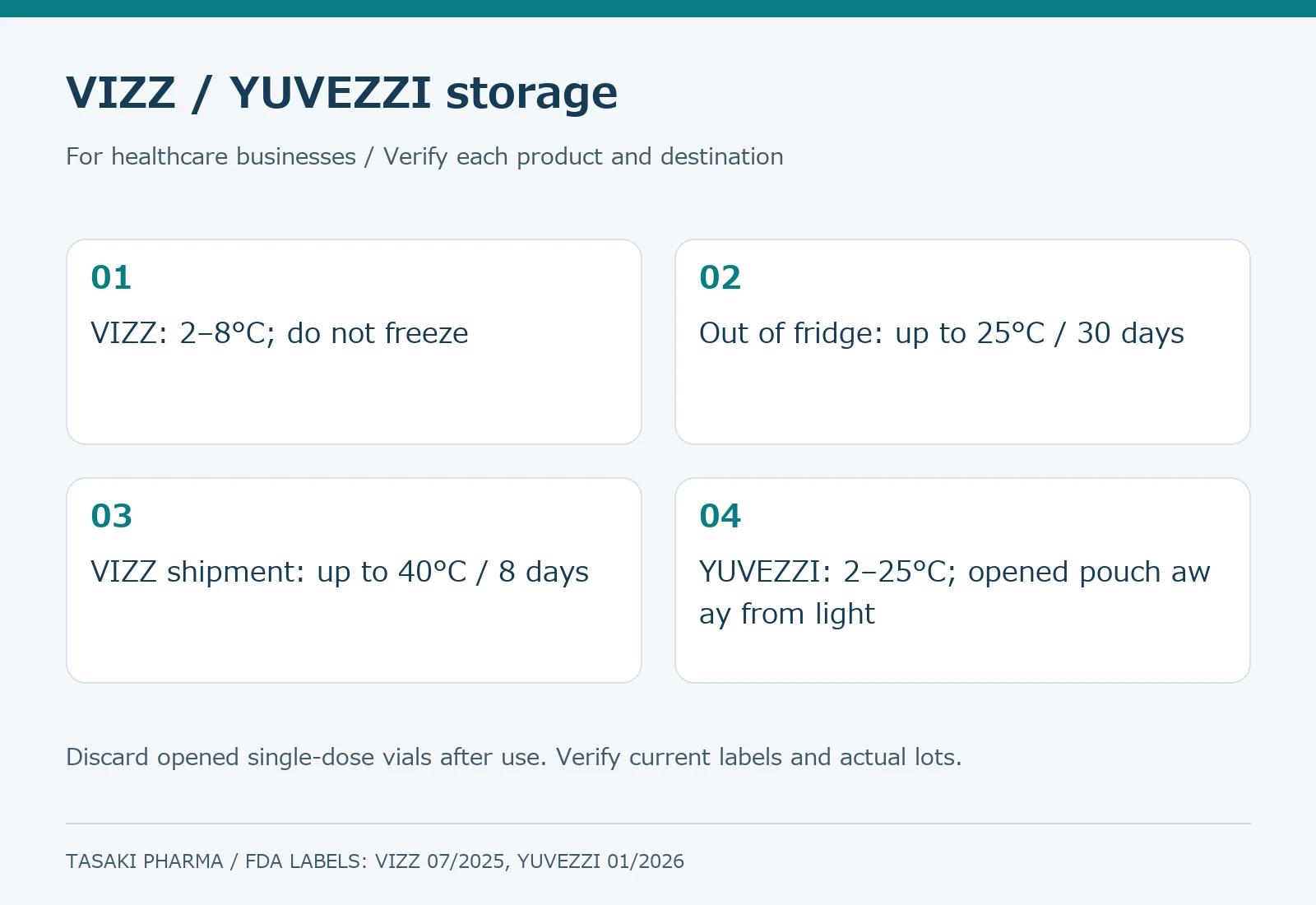
- refrigerated storage at 2–8°C;
- do not freeze;
- once removed from refrigeration, storage at up to 25°C is permitted but the product must be used within 30 days;
- during shipment, temperatures up to 40°C are permitted for no more than 8 days;
- opened single-dose vials are discarded after use.
For international procurement, this means VIZZ should not be simplistically described as “always cold-chain only,” but refrigerated storage is its standard long-term condition. Receiving procedures should verify time out of refrigeration, temperature records and remaining usable period.
YUVEZZI: carbachol 2.75% + brimonidine tartrate 0.1%
YUVEZZI is a fixed-dose combination of carbachol 2.75% and brimonidine tartrate 0.1%. Its 2026 FDA prescribing information indicates treatment of presbyopia in adults, with one drop in each eye once daily.
Carbachol is a cholinergic agonist involved in miosis. Brimonidine is an alpha-adrenergic receptor agonist. The fixed combination was evaluated in the BRIO clinical program.
Clinical evidence
The FDA label reports near-vision outcomes from 30 minutes through eight hours. In BRIO II, at Hour 8, 10.2% of the YUVEZZI group versus 3.2% of the vehicle group met the composite criterion of at least a three-line improvement in binocular uncorrected near visual acuity without at least a one-line loss in binocular uncorrected distance visual acuity.
Consumer marketing may summarize this as “up to 8 hours,” but procurement and medical-information materials should preserve the endpoint context rather than imply that all treated patients obtain the same duration.
Storage
FDA labeling specifies storage at 2–25°C. Unused single-dose vials should remain in the foil pouch and protected from light until use. An opened vial and remaining contents should be discarded immediately.
Compared with VIZZ’s standard 2–8°C refrigerated storage, this difference may simplify inventory and logistics. However, international shipments should still follow the manufacturer or authorized supplier’s validated shipping specifications, especially for routes that may exceed the label storage range.
FDA approval does not automatically authorize supply in another country
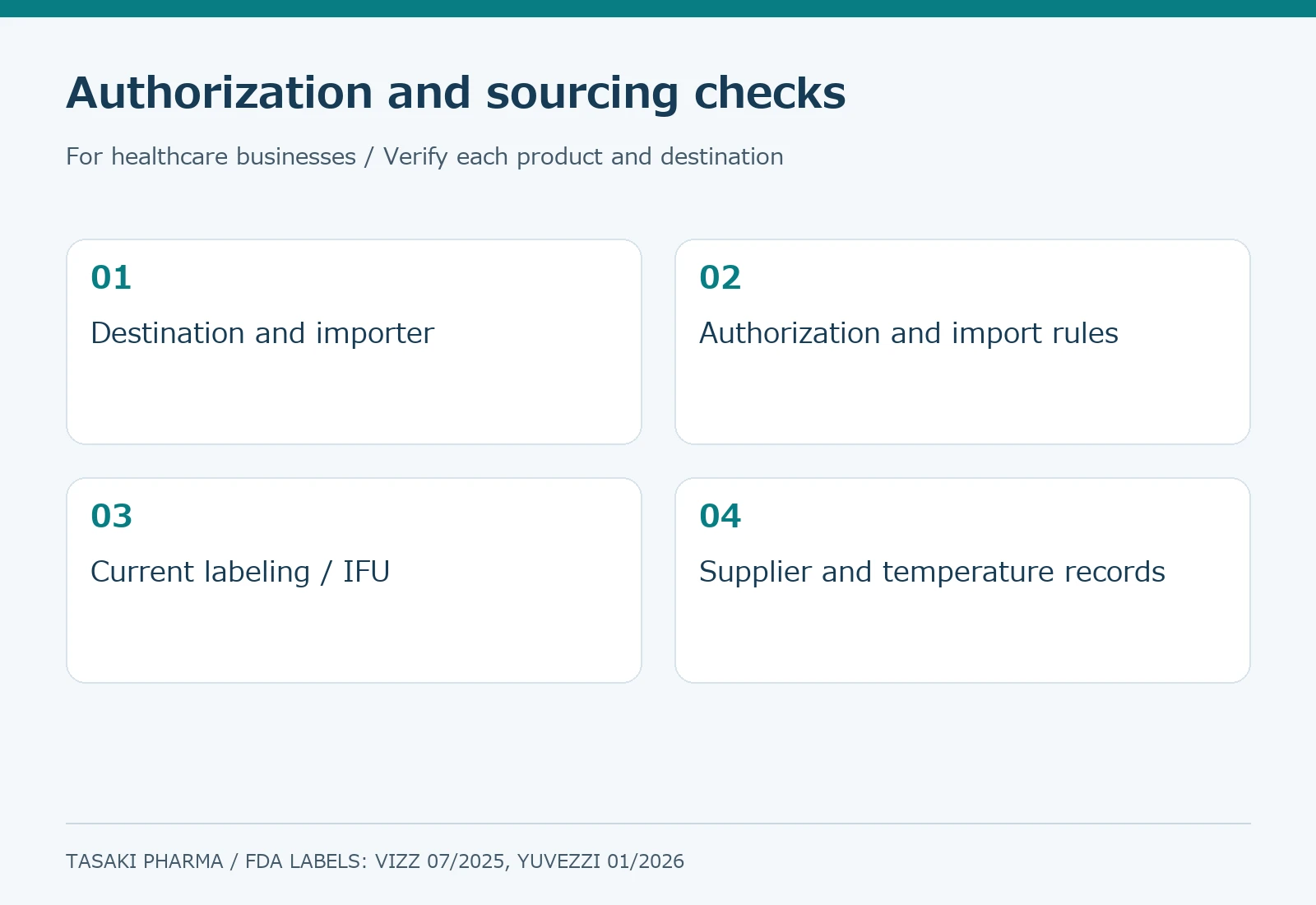
U.S. FDA approval establishes the drug’s U.S. regulatory status. It does not automatically authorize commercial distribution, importation or use in Japan, Taiwan or any other country.
Before international procurement, healthcare businesses should verify:
- destination-market authorization;
- importer and intended use;
- applicable import permit or confirmation process;
- authorized sourcing route;
- lot number and expiration;
- current FDA/market labeling;
- storage and excursion limits;
- shipping packaging and temperature records;
- presentation and single-use requirements;
- recall and safety-information traceability.
For healthcare businesses evaluating presbyopia eye drops
Share the product name, destination country, expected quantity and timing so TASAKI PHARMA can review availability, documentation and shipping requirements case by case.
Ask about sourcing VIZZ, YUVEZZI or other presbyopia eye drops
Procurement implications: VIZZ vs YUVEZZI
Refrigeration
VIZZ is normally stored at 2–8°C. YUVEZZI is labeled for 2–25°C storage. That difference can materially affect long-haul transportation, warehousing and receiving infrastructure.
VIZZ nevertheless has explicit FDA-label allowances for storage at ≤25°C for up to 30 days after removal from refrigeration and shipment at up to 40°C for no more than eight days. Therefore, logistics should be designed from the complete label rather than a binary “cold vs ambient” assumption.
Inventory turnover
Both products use single-dose vials. Procurement teams should evaluate pack configuration, expected monthly usage, lead time and remaining expiry instead of looking only at unit price.
Label updates
Newly approved products may undergo label revisions. Current FDA prescribing information should be rechecked before every significant procurement program and after safety or manufacturing updates.
Availability changes
International availability can change with manufacturer output, distributor allocation, channel restrictions, shipping and destination-country regulations. TASAKI PHARMA accepts case-by-case inquiries regarding VIZZ, YUVEZZI and other overseas pharmaceutical products; availability, price, lead time and documentation should be reconfirmed at the time of inquiry.
Information to provide when requesting a sourcing check
To accelerate an international sourcing review, provide:
- product name;
- destination country;
- healthcare institution/company;
- intended use;
- requested quantity;
- requested delivery timing;
- refrigerated receiving/storage capability;
- required quality or import documents.
If the product has not been selected, the inquiry can start from procurement constraints such as “presbyopia eye drops” or “options that do not require refrigerated storage.”
FAQ
Are both VIZZ and YUVEZZI FDA-approved?
Yes. FDA lists VIZZ with an approval date of July 31, 2025. YUVEZZI’s FDA prescribing information identifies its initial U.S. approval as 2026. These U.S. approvals do not determine regulatory status in other countries.
Does VIZZ always require refrigerated shipment?
Its standard storage condition is 2–8°C. The FDA label also permits room-temperature storage up to 25°C for 30 days after removal from refrigeration and shipment at temperatures up to 40°C for no more than eight days. A real shipment should follow the validated route and supplier instructions.
Can YUVEZZI be stored at room temperature?
The FDA label specifies 2–25°C storage, so refrigeration is not required within that labeled range. Unused vials remain protected from light in the foil pouch.
Does VIZZ’s 10-hour timepoint make it better than YUVEZZI’s 8-hour timepoint?
No head-to-head conclusion can be made from those figures. The products were studied in separate clinical programs with different designs and populations.
Can these products be imported into Japan or Taiwan?
It depends on the product’s local authorization, importer, intended use, quantity and destination-country rules. U.S. FDA approval alone is not sufficient to establish legal import or commercial supply elsewhere.
Conclusion
VIZZ and YUVEZZI are both FDA-approved prescription eye drops for adult presbyopia, but they differ in ingredients, dosing, clinical programs and storage requirements. VIZZ is normally refrigerated at 2–8°C with defined room-temperature and shipping excursions, while YUVEZZI is labeled for 2–25°C storage.
For international procurement, official labeling, destination-market rules, traceability, storage, transportation and current supply status should be checked together. TASAKI PHARMA supports healthcare businesses with case-by-case product research and international procurement inquiries.
Disclaimer: This article is general information for healthcare businesses and does not constitute medical advice or guarantee importability, distribution rights, stock, pricing or clinical suitability in any country.
For healthcare businesses evaluating presbyopia eye drops
Share the product name, destination country, expected quantity and timing so TASAKI PHARMA can review availability, documentation and shipping requirements case by case.
Ask about sourcing VIZZ, YUVEZZI or other presbyopia eye drops
References
- U.S. FDA — Drug Trials Snapshots: VIZZ
- U.S. FDA — VIZZ Prescribing Information
- U.S. FDA — YUVEZZI Prescribing Information
- TASAKI PHARMA — English Home
- TASAKI PHARMA — Yakkan Shomei Guide
This article is intended as general information for healthcare businesses. It does not guarantee clinical suitability, importability, distribution status, availability or pricing of any product. Always prioritize the current official label, destination-market regulations and professional clinical judgment.