Dental bone graft materials are used in implant dentistry, periodontology and oral/maxillofacial procedures when bone volume or defect filling is required. The four broad categories are autografts, allografts, xenografts and alloplasts. No category is universally superior. Product selection depends on defect morphology, space-maintenance requirements, resorption behavior, surgical technique, patient factors, product-specific evidence and the regulatory status in the country where the device will be supplied and used.
For internationally sourced dental biomaterials, clinical characteristics are only one part of the assessment. Procurement teams also need to verify intended use, the current Instructions for Use (IFU), sterilization, single-use status, storage, shelf life, traceability and destination-market registration. This guide summarizes the major graft classes, the role of barrier membranes in guided bone regeneration (GBR), and the publicly verifiable information available for MedPark S1.
Four common categories of dental bone graft materials
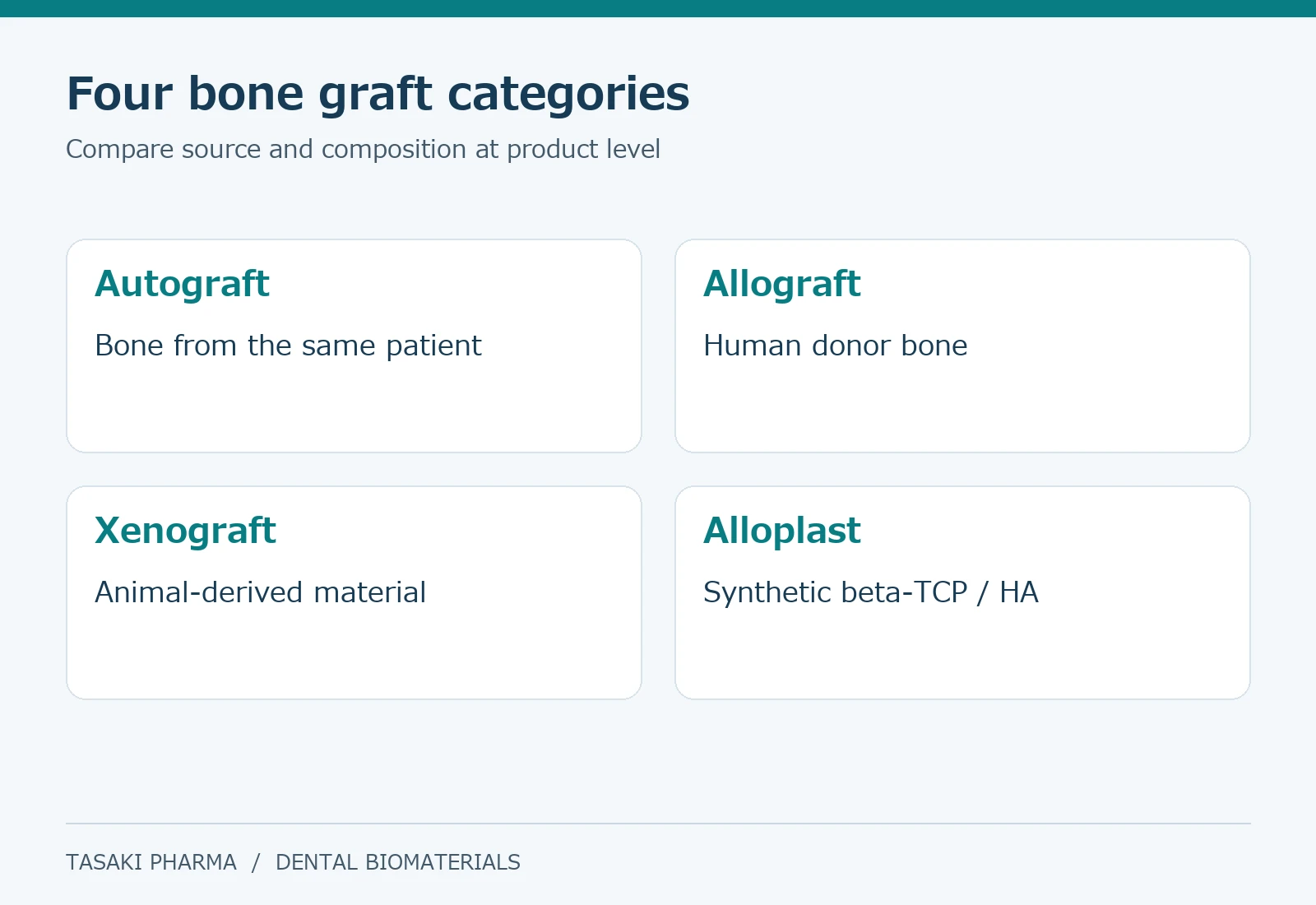
| Category | Source | Typical role | Key procurement checks |
|---|---|---|---|
| Autograft | Same patient | May provide osteogenic cells and biologically active components | Donor site, harvest volume, patient morbidity |
| Allograft | Human donor | Processed human bone with product-dependent properties | Tissue bank, processing, sterilization, traceability, local regulation |
| Xenograft | Animal source | Often used as an osteoconductive scaffold | Species, processing, particle size, resorption, market status |
| Alloplast | Synthetic | Examples include beta-TCP, synthetic HA and biphasic calcium phosphate | Composition, porosity, particle size, resorption, evidence |
Autograft
Autogenous bone is harvested from the same patient. It has long been used as a reference material in augmentation because it can contain osteogenic cells and biologically active components. Practical limitations include the need for a donor site, limited harvest volume and additional patient morbidity.
Allograft
Allografts are processed human donor bone. Their biological and handling characteristics vary with processing. Tissue-bank controls, sterilization, donor screening, traceability and local legal requirements are therefore central to both clinical and procurement review.
Xenograft
Xenografts are derived from another species, commonly bovine or porcine sources in dental applications. Processed bovine-derived hydroxyapatite is widely used as an osteoconductive scaffold. Source tissue, manufacturing, particle size, porosity, resorption behavior and handling can differ substantially between products, so claims should be assessed at product level.
Alloplast
Alloplasts are synthetic substitutes such as beta-tricalcium phosphate, synthetic hydroxyapatite and biphasic calcium phosphate. Their composition can be standardized, but clinical behavior still depends on chemistry, pore structure, particle size and manufacturing. Selection should be based on the actual device and intended procedure, not simply on whether the material is natural or synthetic.
GBR combines space maintenance, graft materials and barrier membranes
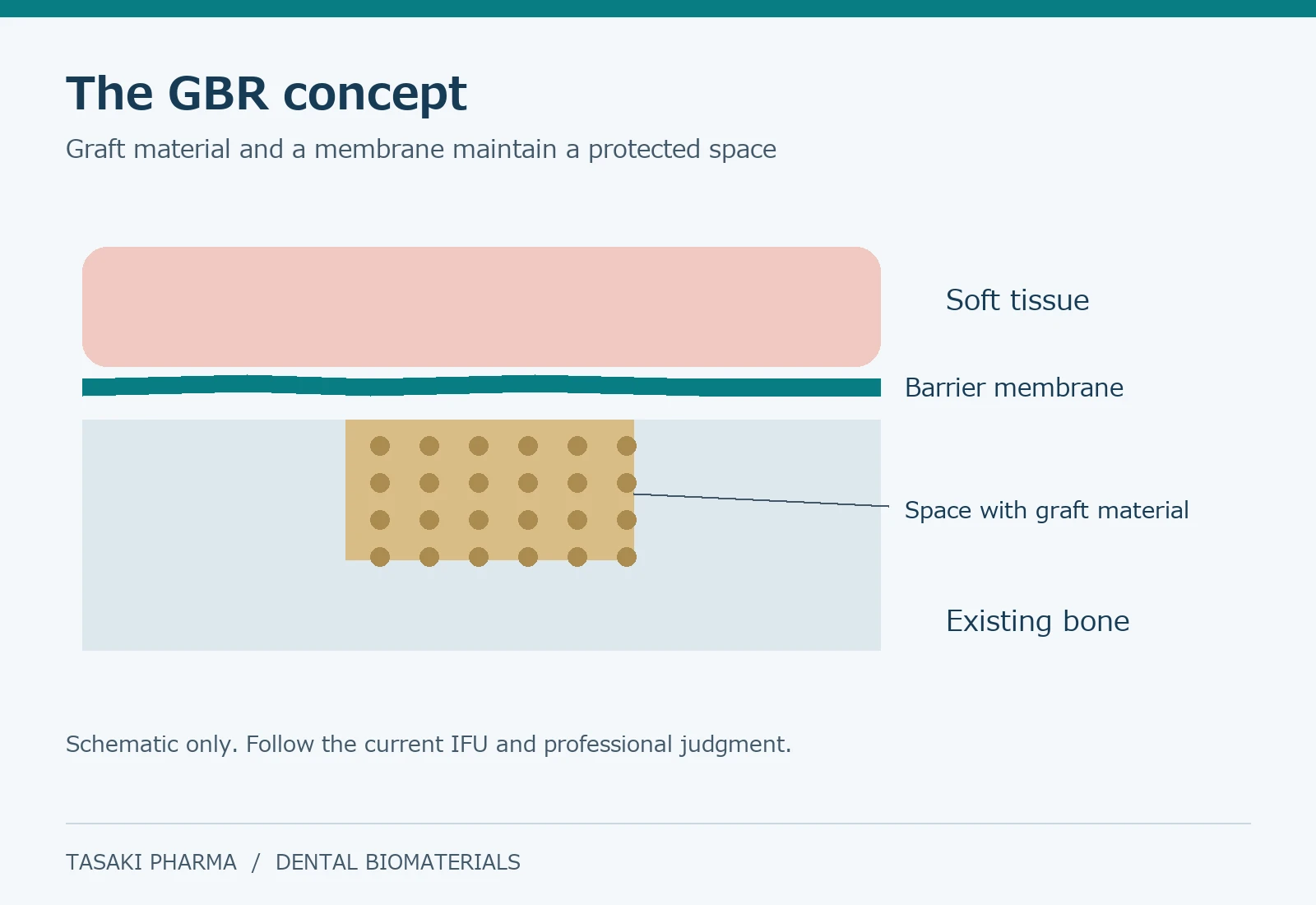
Guided bone regeneration aims to maintain a protected space for bone formation while limiting early soft-tissue invasion. Barrier membranes may be resorbable or non-resorbable. Resorbable collagen membranes are widely used because they do not require a second procedure for removal, but their mechanical strength and degradation behavior vary with source material, crosslinking and manufacturing.
The graft and membrane should therefore be evaluated as a system. Defect morphology, stability, required barrier duration, material handling, wound closure and evidence for the specific devices all influence selection.
Seven checks before comparing or sourcing a dental bone graft
- Source and composition: autogenous, allogeneic, xenogeneic or synthetic; confirm species and processing for animal-derived materials.
- Intended use: confirm indications in the current IFU and the destination market’s registration or clearance.
- Particle size and form: powder, granules, chips and moldable forms can behave differently during handling and defect adaptation.
- Space maintenance and resorption: match product behavior to the defect and planned healing period.
- Sterilization and single-use status: confirm sterilization method, package integrity, reuse restrictions and re-sterilization instructions.
- Storage and shelf life: verify temperature, light protection, transportation requirements and the expiration date on the actual product.
- Regulatory and quality documentation: verify market-specific registration/clearance, IFU, UDI where applicable, lot/expiry data, declarations and quality documents.
MedPark S1: what can be verified from FDA and manufacturer information
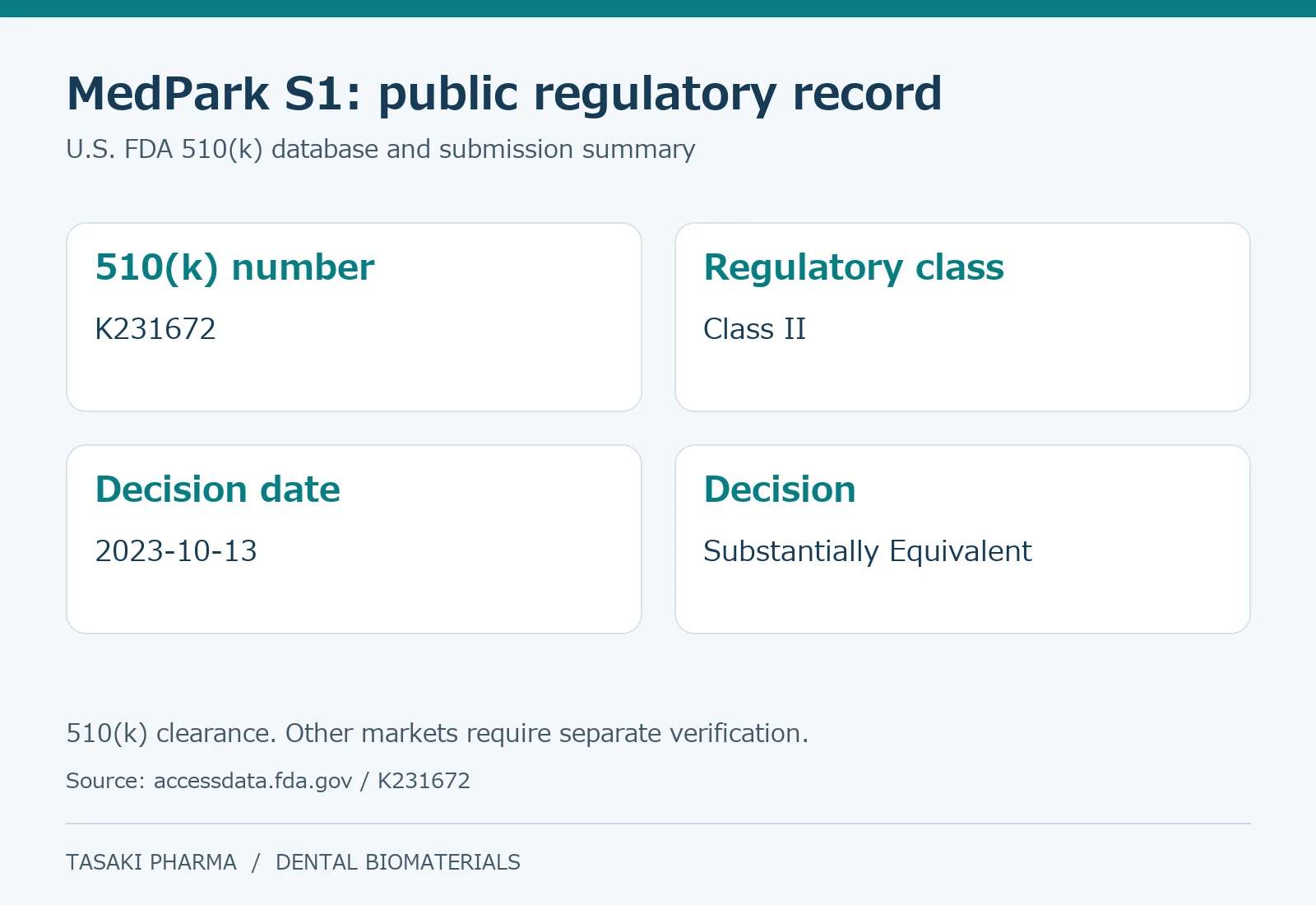
MedPark S1 is an animal-source dental bone graft manufactured by MedPark Co., Ltd. In the U.S. FDA 510(k) database, S1 is listed under K231672 as a Class II dental device, “Bone Grafting Material, Animal Source.” FDA issued a substantially equivalent determination on October 13, 2023. The accurate regulatory description is therefore that S1 received FDA 510(k) clearance.
The FDA 510(k) summary describes S1 as mineralized hydroxyapatite derived from bovine cancellous bone combined with hydroxypropyl methylcellulose (HPMC). The documented particle ranges are 0.2–1.0 mm for the powder type and 1.0–2.0 mm for the chip type. The submission describes the device as gamma-irradiated and single-use.
FDA’s indications include alveolar ridge augmentation or reconstruction, infrabony periodontal defects, defects after root resection/apicoectomy/cystectomy, extraction-socket preservation, maxillary sinus-floor elevation, and periodontal or peri-implant defects used in conjunction with products intended for GTR/GBR.
MedPark’s public product information describes hydration with saline and kneading to create a moldable form before placement. The current public page states shaded room-temperature storage at 1–30°C, single use and a five-year expiration period. Regulatory submissions and later product labeling can contain different version-specific information; procurement teams should therefore verify the current destination-market IFU and the actual lot label before supply or use.
Collagen membranes and MedPark Colla-DM
Malaysia’s Medical Device Authority registry lists “COLLA-D RESORBABLE COLLAGEN MEMBRANE” under the MedPark brand. The registry describes Colla-DM as a bovine-derived resorbable collagen membrane used to cover the surgical site, limit foreign-tissue invasion and support guided bone regeneration.
More detailed claims about degradation time, mechanical performance, comparative superiority or clinical outcomes should be checked against the current market-specific IFU, regulatory documents and independent evidence before clinical use or procurement. Manufacturer marketing claims and independently verified facts should be clearly separated.
TASAKI PHARMA states that it holds pharmaceutical and medical-device GDP certification in Taiwan and supports international procurement for medical-related businesses. If you are evaluating a dental bone graft or GBR membrane, provide the product/manufacturer name, destination country, intended use and expected quantity so that product availability and documentation requirements can be reviewed case by case.
International procurement checklist
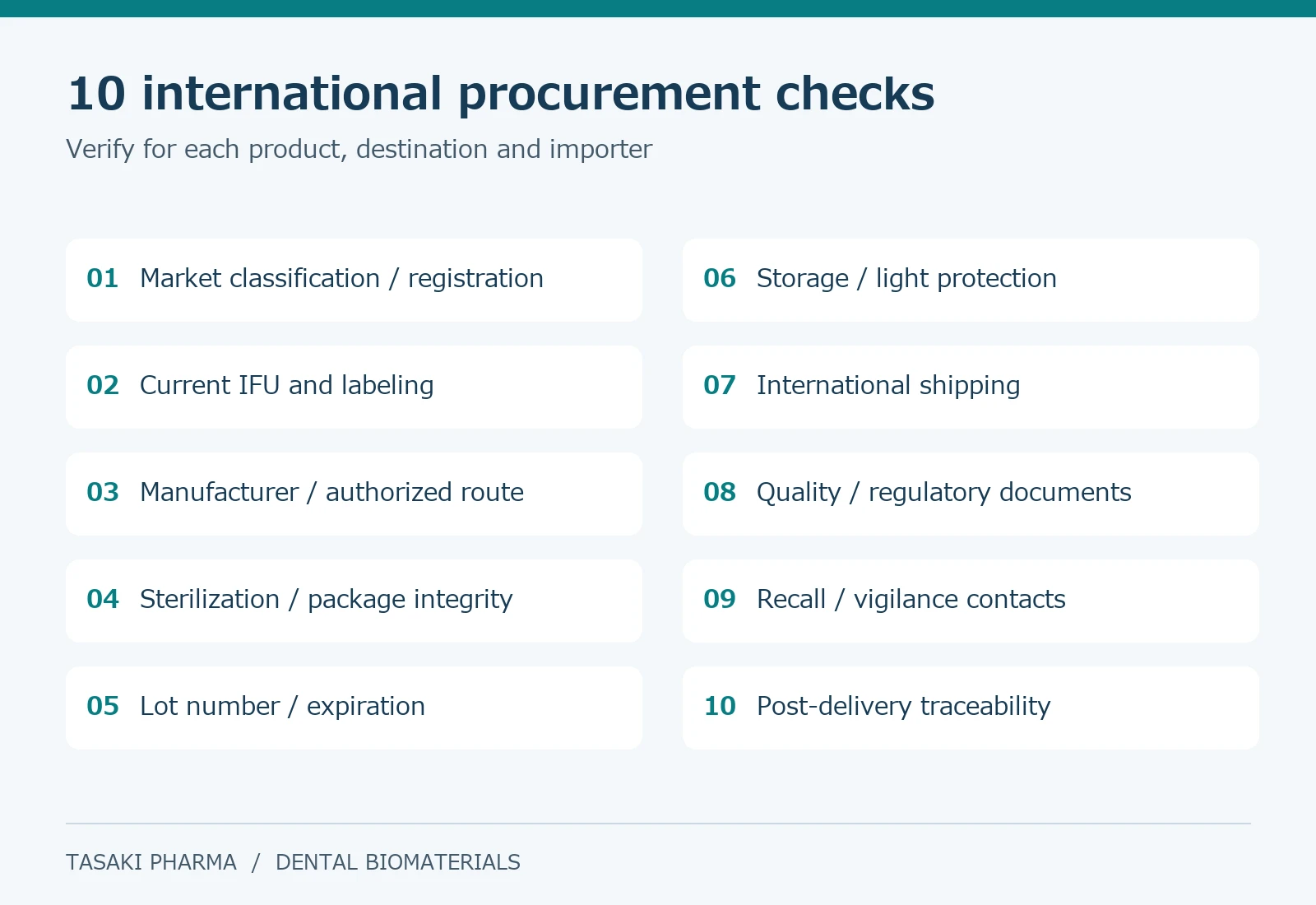
- Destination-market device classification and registration
- Current IFU and labeling
- Manufacturer and authorized distribution route
- Sterilization method and package integrity
- Lot number and expiration date
- Storage temperature and other environmental conditions
- International shipping conditions
- Destination-market quality and regulatory documents
- Recall and vigilance contact points
- Post-delivery traceability
A U.S. 510(k) clearance does not by itself establish that the device can be freely distributed or used in Japan, Taiwan or any other market. Regulatory status must be assessed separately for each destination.
FAQ
Is a xenograft better than a synthetic bone graft?
Not inherently. The appropriate choice depends on the defect, required stability and space maintenance, resorption profile, surgical technique, patient factors, product-specific evidence and the applicable regulatory framework.
Is MedPark S1 FDA approved?
FDA lists S1 under 510(k) K231672 with a substantially equivalent determination. The precise description is FDA 510(k)-cleared, not PMA-approved.
Can S1 be used in GBR procedures?
FDA’s indications include periodontal and peri-implant defects in conjunction with products intended for GTR/GBR. Actual use must follow the current labeling and regulations in the destination market.
Can an overseas dental bone graft be imported into Japan, Taiwan or another market?
Requirements vary by device classification, importer, quantity, intended use and destination. Market-specific registration and import procedures must be checked before shipment.
Conclusion
Dental bone graft procurement should be based on product-specific evidence and regulatory documentation rather than broad assumptions about material categories. MedPark S1 has verifiable FDA 510(k) information as a bovine-derived animal-source dental bone graft, while handling and storage information is available on the manufacturer’s public product page. For international supply, verify destination-market status, current IFU, lot-specific labeling, sterilization, storage and traceability before use.
This article is intended for healthcare businesses and professionals as general information. It does not guarantee the indication, use, importability or distribution status of any specific product. Always prioritize current market authorization/registration, IFU, labeling, applicable law and professional clinical judgment.
References
- FDA 510(k) Database — S1 K231672
- FDA 510(k) Summary PDF — K231672
- MedPark Official — S1 Product / IFU Information
- Malaysia Medical Device Authority — COLLA-D Resorbable Collagen Membrane
- PMC — Mechanisms of Guided Bone Regeneration: A Review
- PubMed — Barrier Membranes for GBR: Recent Advances in Collagen Membranes
- TASAKI PHARMA — 日本語ホーム
- TASAKI PHARMA — English Home
- TASAKI PHARMA — 繁體中文首頁
- TASAKI PHARMA — グローバル調達戦略
- TASAKI PHARMA — 薬監証明ガイド
- TASAKI PHARMA — 未承認薬の広告掲載