NADH, NAD+ and NMN appear in several different product contexts, including research reagents, food or supplement ingredients, and pharmaceutical development. A vial format or a “research reagent” label therefore does not, by itself, determine whether a product can be supplied or used for a particular healthcare purpose.
For an OEM or contract-manufacturing project, the first question should not be “what concentration should we make?” but rather: who will use the product, in which market, and for what intended use? This guide outlines the product-classification, documentation and sourcing checks that healthcare businesses should complete before moving a NADH, NAD+ or NMN vial project into manufacturing.
NADH, NAD+ and NMN: start with the basic distinction
NADH is the reduced form of NAD+
PubChem describes NADH as the reduced form of NAD+, with the pair participating in oxidation-reduction reactions and electron transfer. That biochemical relationship is useful background, but it does not establish the efficacy, absorption, speed of action or suitability of a particular commercial product.
When evaluating an OEM product, general biochemical information should be kept separate from product-specific evidence, specifications, intended use and regulatory status.
NMN is an intermediate in NAD+ biosynthesis
β-NMN (β-nicotinamide mononucleotide) is an intermediate in NAD+ biosynthesis and is also distributed as a research reagent. The same ingredient name can appear in products made under very different specifications and for very different intended uses.
For procurement purposes, the ingredient name alone is not enough to establish equivalence between a research reagent, a food ingredient or another product type.
Separate research-use products from products intended for people
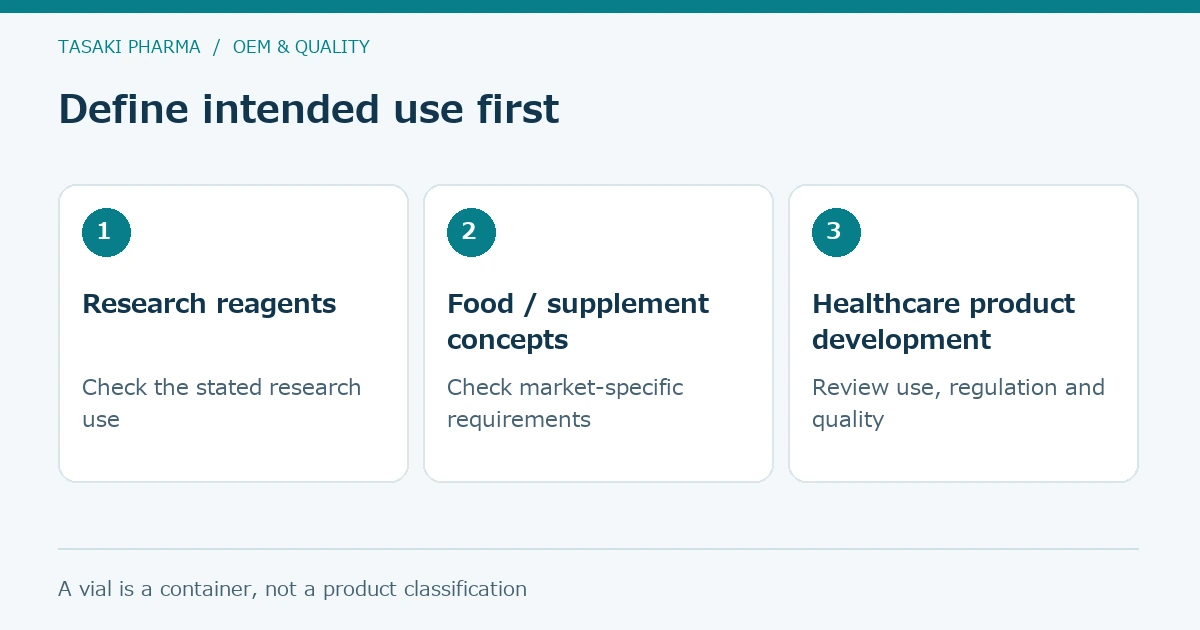
Intended use should be defined before an OEM specification is developed.
For example, Oriental Yeast states on its official β-NMN reagent page that the product is a research reagent and is not for administration to people as a pharmaceutical, supplement or food product. That statement is product-specific, but it illustrates a broader procurement principle: a product supplied under research-use conditions should be handled within the scope of that stated use.
A research-use product should not be assumed to be appropriate for another use merely because the ingredient name is the same. Conversely, the existence of a research reagent does not mean that development of a separate product for another lawful use is automatically impossible. The relevant requirements must be determined for the particular project.
As a practical sequence, define the intended use, destination market, likely product classification, required quality/regulatory documentation, and only then the manufacturing partner and detailed specification.
FDA guidance on “Research Use Only” (RUO) is primarily written for in-vitro diagnostic products. It should not be generalized as a direct rule for NADH or NMN vials. It is nevertheless a useful illustration of an important concept: research-use labeling and the manufacturer’s actual intended use should be consistent.
Ten checks before starting a NADH or NMN vial OEM project
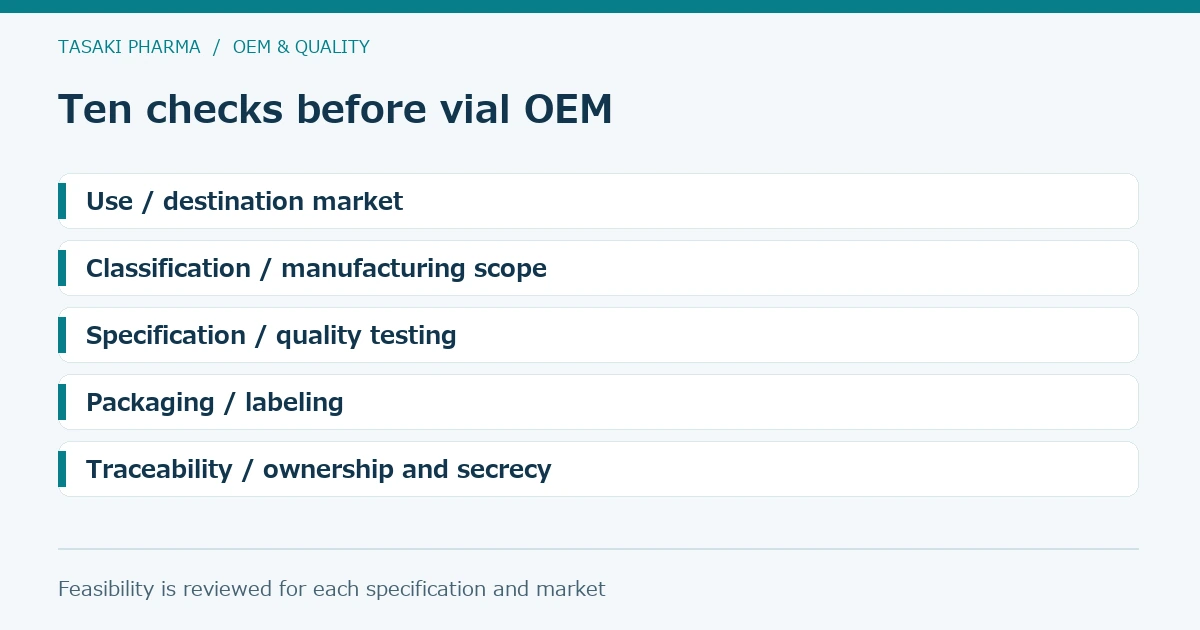
1. Intended use
Define whether the concept is for research, product development, food/supplement use, or another healthcare-related purpose. If intended use remains vague while packaging and specifications are fixed, the project may later conflict with applicable requirements.
2. Destination market
Requirements may differ across Japan, Taiwan, South Korea, Singapore, the United States and other markets. Specify not only where the product will be manufactured, but where it will be supplied.
3. Product classification and required procedures
An ingredient name or dosage form does not determine product classification on its own. Intended use, labeling, distribution and the destination jurisdiction all matter. Where necessary, confirm the applicable pathway with the relevant authority, importer or regulatory professional.
4. Manufacturer and manufacturing scope
Verify the actual manufacturing site, the product forms it is qualified to manufacture, its quality system and the scope relevant to the proposed product.
TASAKI PHARMA publicly describes an OEM/ODM service supported by partner pharmaceutical manufacturers operating in accordance with PIC/S GMP standards. Feasibility for a specific NADH or NMN project still requires case-by-case review of intended use, specification, quantity and destination market.
5. Identity, specification and analytical documentation
Review the ingredient identity and chemical form, specification, analytical method, certificate of analysis (CoA), storage conditions and lot information. Avoid relying on a generic “high purity” claim without knowing the method, acceptance criteria and batch to which the result applies.
6. Quality checks appropriate to the product
Required testing depends on product classification and intended use. Rather than applying one universal test list to every NADH or NMN product, determine the product category first and then agree with the manufacturing partner on the appropriate quality documentation and testing.
7. Container, packaging and stability
For vial products, review the container and closure, light protection where relevant, pack configuration, storage temperature, shelf life, stability support and transportation conditions. A lyophilized presentation should not automatically be treated as “stable” without product-specific stability information.
8. Labeling and claims
Research-use products and products for other intended uses require different approaches to labeling and claims. Product name, ingredient, quantity, lot, expiry, storage and intended-use statements should be reviewed for the target market.
Research findings about an ingredient should not automatically be converted into performance or health claims for a specific OEM product.
9. Lot traceability and quality information
For ongoing supply, confirm how raw-material lots, manufacturing lots, shipment records, quality documents, storage or transport information and issue-reporting channels will be linked and retained.
10. OEM ownership and confidentiality
Before manufacturing, clarify ownership of the brand, specifications and data; use of test results; minimum order requirements; exclusivity; confidentiality; and what happens if specifications change or manufacturing is discontinued.
Why ingredient names alone are not enough
NADH, NAD+ and NMN are discussed in biochemical research, research-reagent supply, food and supplement markets, and healthcare product development. A search result that contains the same ingredient name may therefore describe a product with a completely different legal classification, quality system and intended use.
A vial is a container format, not a regulatory classification
The fact that a material is supplied in a vial does not automatically make it a research product, a pharmaceutical or any other particular category.
“Research use” is not a human-use authorization
A research-use statement should not be interpreted as evidence that a product has been authorized or evaluated for administration to people.
Ingredient research is not the same as product evidence
Even when studies exist for NADH or NMN as substances, those findings should not be treated as proof of the performance of a specific OEM product without product-specific support.
Compare suppliers on documentation, not only on price
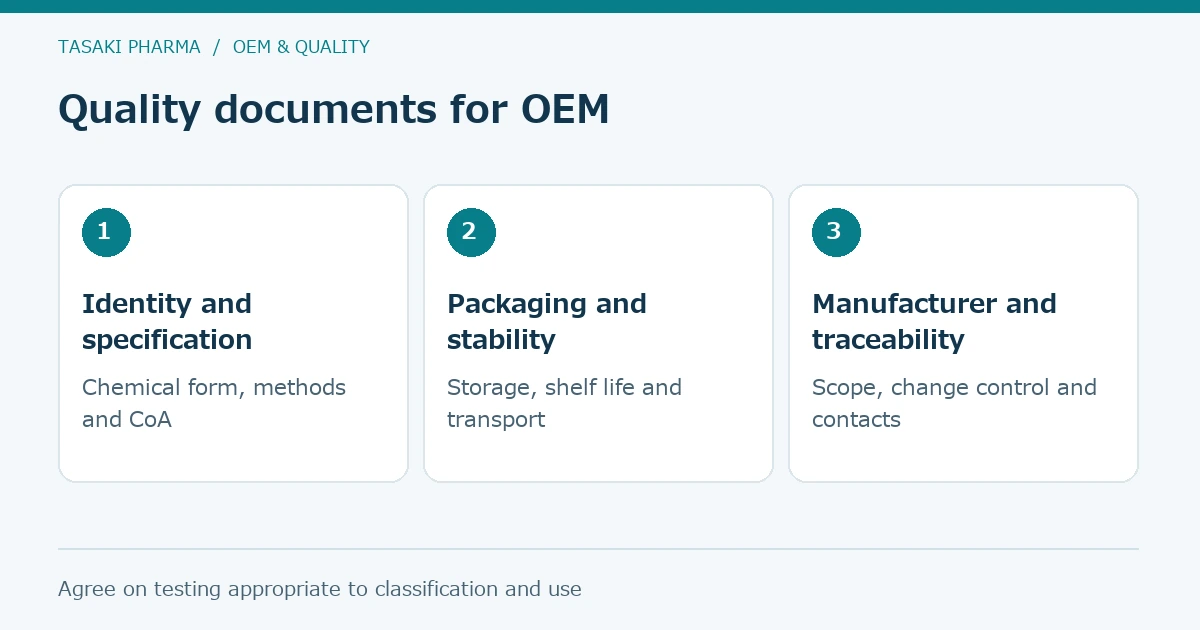
When two suppliers offer materials with the same ingredient name, compare more than the unit price. Confirm whether the chemical form, manufacturing site, specification, analytical method, storage conditions and remaining shelf life are actually equivalent. A lower-priced material may not be directly comparable if the documentation is incomplete or if it was produced for a different intended use.
For cross-border projects, also confirm which party will provide export documents, who will act as importer in the destination market, how lot-level quality documents will be transferred, and how changes to the specification or manufacturing site will be communicated. These operational details often determine whether an OEM project can be maintained after the first production run.
For healthcare businesses evaluating NADH, NAD+ or NMN OEM and international sourcing
Share the ingredient or concept, intended use, destination market, desired format and expected quantity with TASAKI PHARMA for a project-specific feasibility review.
What to prepare when contacting TASAKI PHARMA
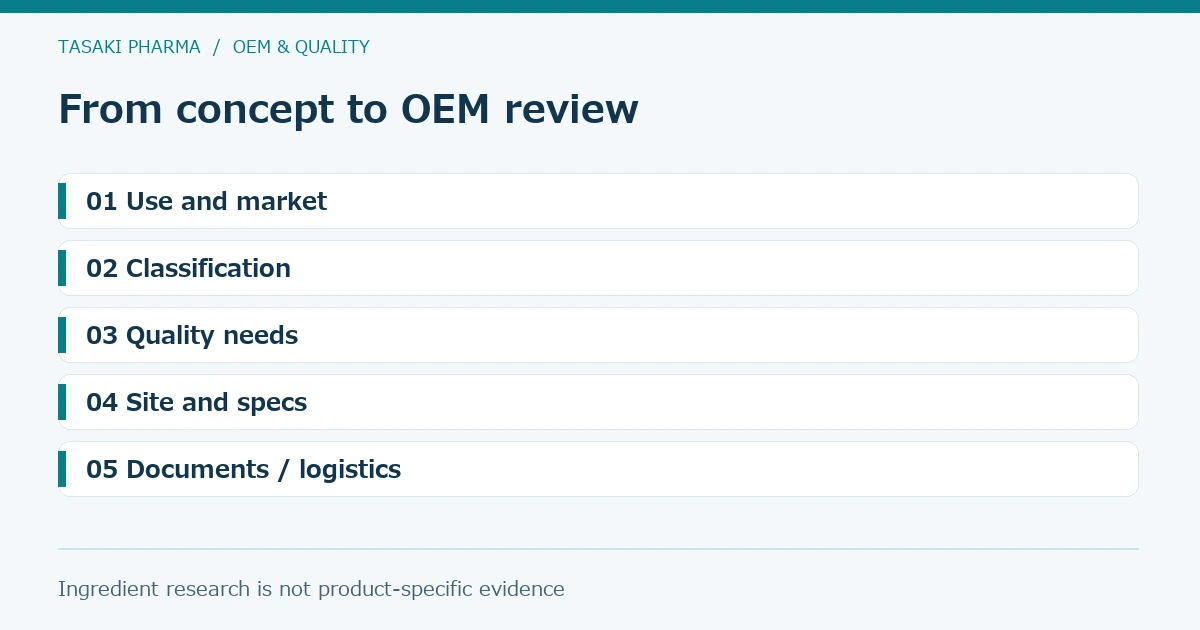
TASAKI PHARMA’s public website describes an OEM/ODM process that covers planning, testing and regulatory preparation, manufacturing and delivery through partner facilities. To make an initial feasibility review more efficient, prepare the ingredient or concept, intended use, destination market, desired format and container, expected quantity, required documentation, storage or shipping constraints, target timeline and branding requirements.
Specific availability should be confirmed for each project rather than inferred from the presence of NADH, NAD+ or NMN in the market.
Frequently asked questions
Are NADH and NAD+ the same?
No. NADH is the reduced form of NAD+, while NAD+ is the oxidized form. For product development, each material’s specification, stability and intended use still need to be evaluated separately.
Is an NMN vial automatically a pharmaceutical?
No conclusion can be drawn from the ingredient and container alone. Intended use, labeling, manufacturing and distribution model, and the destination jurisdiction all affect the required assessment.
Can a research reagent be used directly by a clinic?
A research-use label should not be treated as authorization for human use. Whether another use is permissible must be assessed for the specific product, intended use and jurisdiction.
Can TASAKI PHARMA manufacture NADH or NMN vials?
TASAKI PHARMA publicly offers OEM/ODM services. Feasibility for a specific NADH, NAD+ or NMN project depends on intended use, destination market, specifications, quantity and manufacturing requirements, and should be confirmed individually.
Conclusion
For NADH, NAD+ and NMN vial OEM projects, intended use, destination market, product classification and quality requirements should be defined before detailed manufacturing specifications are fixed.
The same ingredient name can appear in research reagents, food or supplement products and other healthcare-development contexts. Avoid treating terms such as “vial,” “high purity” or “GMP” as sufficient proof of suitability. Manufacturer identity, specification, CoA, stability, storage and shipping, labeling and lot traceability should be reviewed together.
For healthcare businesses evaluating NADH, NAD+ or NMN OEM and international sourcing
Share the ingredient or concept, intended use, destination market, desired format and expected quantity with TASAKI PHARMA for a project-specific feasibility review.
Related information
- NAD+ IV products and international sourcing
- Global procurement strategies for stable pharmaceutical supply
- TASAKI PHARMA OEM/ODM
References
- PubChem: NADH
- Oriental Yeast: β-Nicotinamide mononucleotide / β-NMN
- FDA: Definitions and General Oversight: Laboratory Developed Tests FAQs